How Field Mapping Breaks When a Third-Party API Changes Its Schema
Silent schema changes in third-party APIs quietly corrupt data pipelines with no error signals.
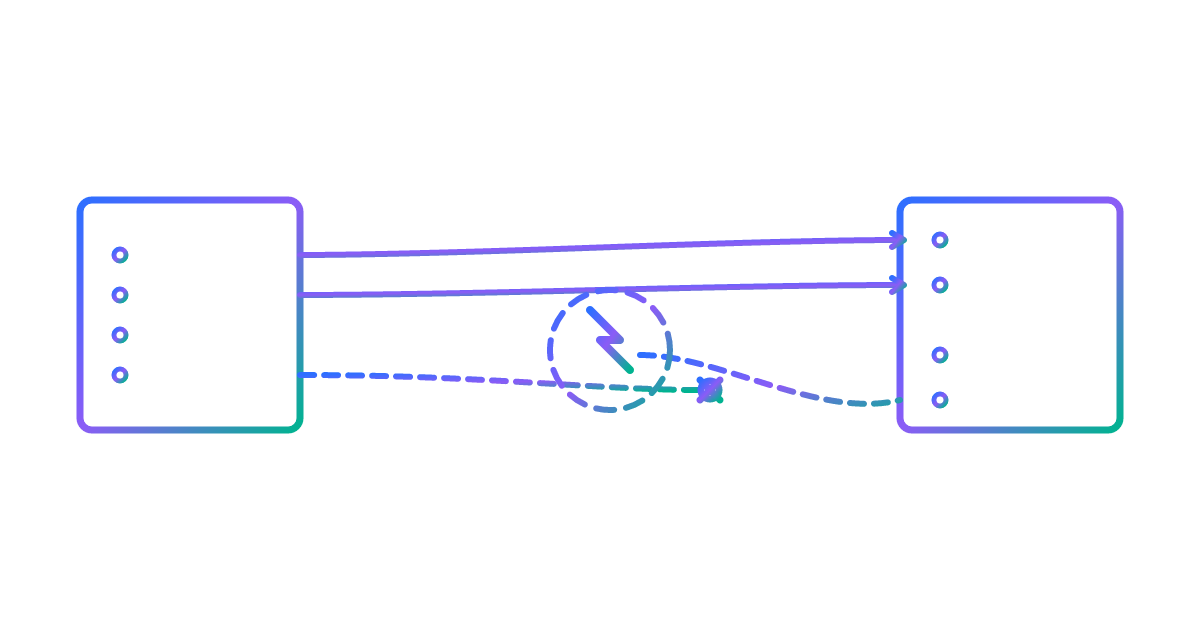
Field mappings break in predictable ways when third-party APIs change their schemas, and most of those breaks are completely silent. Think of a field mapping like a postal address written in ink on an envelope. The moment the building moves, the letter still gets sent, the route still gets run, and nobody flags the error because the package never arrives.
The average application runs on somewhere between 26 and 50 APIs, per Postman's 2024 State of the API Report. Each one of those APIs can change independently. Each change can quietly invalidate the field mappings your integration depends on. And with daily deployments becoming more common and release cycles shrinking, those APIs are changing more frequently than they used to. This is not a future risk to plan for. It is a current operating condition that engineering teams are already absorbing, often without realizing how fragile their mapping layer actually is.
What a Field Mapping Does and Why It Breaks
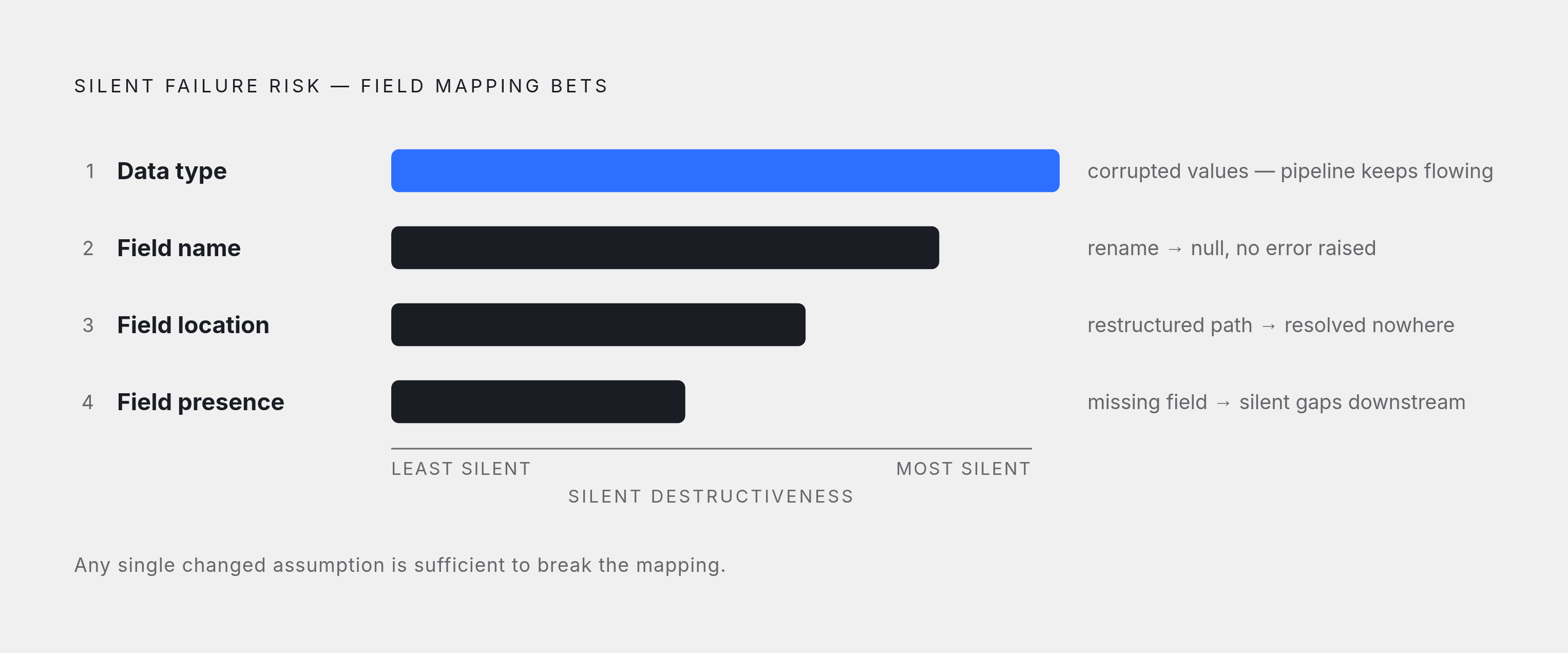
A field mapping is a contract. It says: field X in the source equals field Y in the destination, in this format, at this location, and with this expected presence.
That contract is written at a point in time, against a specific version of the upstream API. It is a snapshot. And once you write it, nobody automatically updates it when the API changes.
The mapping keeps running against assumptions that are no longer true.
Here is exactly what a field mapping bets on every time it executes:
- Field name. The exact string used to reference the value.
- Data type. Whether the value is a string, integer, decimal, boolean, or array.
- Field location. Whether the field lives at the root of the response or buried inside a nested object.
- Field presence. Whether the field is required, optional, or only shows up under certain conditions.
Any one of these breaking is enough to cause a failure. The mapping does not need multiple things to go wrong at once. One changed assumption is sufficient.
Schema evolution is manageable when it is anticipated. Teams that build detection into their mapping layer can catch a change, adjust, and keep moving. The damage happens when the mapping layer has no mechanism to notice that the contract shifted. Then the pipeline keeps running, the data keeps loading, and the problem compounds quietly in the background.
The rest of this piece is about exactly how that happens, one class of schema change at a time.
How Field Renames Produce Silent Null Values
This is the one that gets people. Not because it is complicated, but because it looks like nothing went wrong.
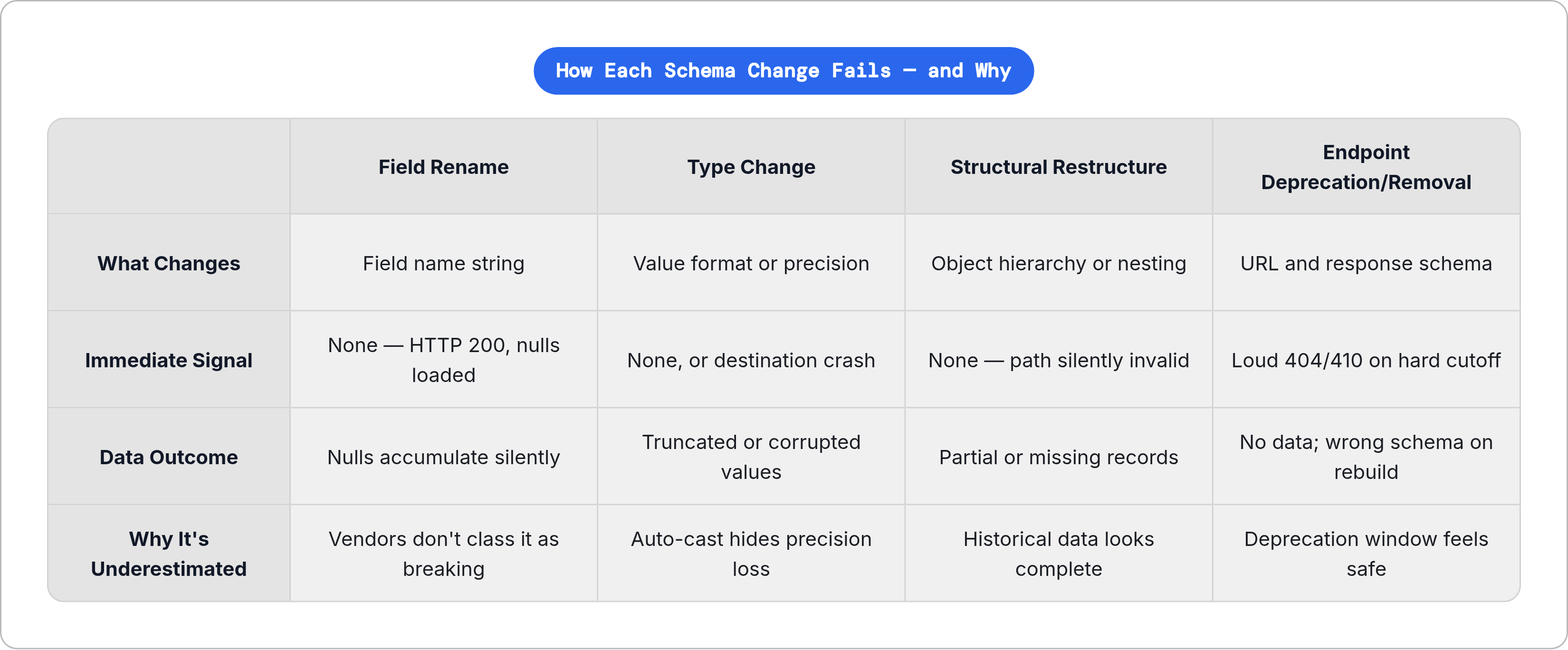
When an API renames a field, the mapping layer does not see a rename. It sees the old field disappear and a new, unrelated field appear in its place. The mapping is still pointing at the old name. The API no longer returns anything at that name. So the destination gets null values. Not an exception. Not an HTTP error. Just null.
A real example: Harvest renamed client.name to client.display_name. Both fields coexisted temporarily during a transition period, so no breaking change was officially declared. Teams relying on client.name received empty strings. No error. No alert. The pipeline reported success every single time.
Here is why this failure mode is especially dangerous:
- The sync completes cleanly. HTTP 200. Green checkmark.
- Null is often a valid state in destination tables, so automated monitoring will not flag it.
- The damage accumulates over days or weeks before anyone notices a gap in a dashboard.
A 2026 systematic review found that nearly half of precondition-violating exceptions from behavioral breaking changes lack meaningful error messages. That is the category renames fall into: changes that execute successfully but produce wrong results. The pipeline does not know it is wrong.
It is worth noting why renames happen so often in the first place. API developers doing internal code cleanups or field standardization efforts frequently view renames as non-destructive. The old field was a bit ambiguous. The new name is cleaner. No data is being removed. From their perspective, it is a tidy improvement. The external contract impact is just not part of the mental model.
How Type Changes Corrupt Data That Keeps Flowing
A renamed field at least produces nulls, which occasionally get noticed. A type change is worse. The field keeps arriving. The data keeps loading. Everything looks fine until someone looks closely enough at the numbers.
The format changes, but the field stays put. A Unix timestamp becomes an ISO 8601 string. A boolean becomes a 0 or 1 integer. A string becomes an integer. Or the one with real financial consequences: order_amount changes from INTEGER to DECIMAL(10,2) to support fractional pricing.
Pipelines that do not handle that type promotion will truncate decimals, throw casting errors, or silently round every order amount to the nearest whole dollar. Revenue figures that look plausible but are systematically wrong. Business decisions made on bad data before anyone checks the math.
The destination system's behavior makes this worse, because it is inconsistent:
- Some databases auto-cast and lose precision without saying a word.
- Others throw a schema mismatch error and halt the pipeline entirely.
- The same type change produces different symptoms in different environments.
That inconsistency is the hidden variable. Teams that have the pipeline crash the same day they push a type change learn about it fast and fix it fast. Teams whose destination silently auto-casts have a corrupted dataset quietly growing in the background. By the time someone notices, the question is not just what broke but how far back the damage runs.
A crashed pipeline gets fixed the same day. Corrupted data requires a full audit. That asymmetry is why type changes often turn out to be more expensive than outright failures, even though they look much less dramatic on the surface.
How Nested Restructuring Breaks Mapping Paths
Field mapping paths encode location, not just identity. response.customer.email is not just a field name. It is a set of directions: start at the response root, go into the customer object, retrieve the email value. If the API restructures that hierarchy, the directions lead nowhere.
When an API flattens a nested object, promotes a field to root, or moves fields into an array, the path itself is invalid. The mapping does not fail gracefully. It just points to a location that no longer exists.
FreshBooks deprecated tax1name and tax2name in favor of a taxes array. Old responses still included the flat fields for existing integrations during a transition window. But new invoices only populated the taxes array. Teams that had not updated their mapping received tax data on historical records and silently missed it on every single new invoice going forward.
The partial-data problem this creates is particularly nasty:
- Historical data looks complete.
- New data is silently incomplete.
- The discrepancy only surfaces when someone compares aggregates over time and the trend line looks wrong.
Array versus scalar promotion deserves special mention. Code written to read a single scalar value from a path will fail or behave unpredictably when that path now returns an array. The logic is not wrong. The structure it was built against just changed shape underneath it.
REST APIs move toward more normalized, nested structures as they mature. Flat-to-nested migrations are a known pattern in API evolution. If you have enough integrations running long enough, you will see this.
How Endpoint Deprecations Cut Off the Data Source
Deprecation and removal both break the mapping. They just do it on different timelines and with different warning signals.
A deprecated endpoint keeps working during the window, which creates a false sense of safety. The mapping runs fine. The data loads. There is no urgency. Then the hard cutoff date arrives and the entire data source goes dark. Teams that did not treat the deprecation notice as a serious deadline suddenly have an outage.
Endpoint removal cascades differently from field removal. The failure is immediate and loud. The pipeline does not return wrong data. It returns no data. A 404 or a 410 is hard to ignore.
But here is the trap: replacement endpoints frequently have different response schemas. The migration is not just swapping a URL. It requires remapping every field against the new response structure. Teams that treat endpoint migration as a simple find-and-replace often rebuild the pipeline, get it running again, and end up with a silent data-quality problem on the other side because the new mapping was done naively against a changed schema.
API versioning strategies vary widely across vendors. Consumers often do not discover the deprecation schedule until late, sometimes because the announcement was buried in a changelog, sometimes because no one on the consuming team owns the relationship with the upstream provider.
Stripe is frequently cited as a benchmark here: over a decade of backward compatibility maintained across pinned versions, with transformation complexity absorbed internally. That is a genuinely impressive engineering commitment. It is also an enormous, sustained investment that most API vendors simply do not make. Expecting that level of stability from every upstream API is not a reasonable assumption.
Why Semantic Versioning Does Not Protect Downstream Mappings
The SemVer promise sounds clean. Major version bump means breaking change. Minor means new backward-compatible features. Patch means bug fixes. You track the version number and you know what to expect.
In practice, this promise breaks down regularly.
A 2024 ACM study of 30,548 dependencies found that 2.30% of dependency updates had behavioral breaking changes that impacted client tests, and most were introduced during non-major version updates. The version signal said safe. The behavior said otherwise.
A large-scale analysis of hundreds of real-world Java libraries found that roughly 14.78% of API changes broke compatibility across their release histories. That is the baseline frequency of breaking changes in the wild.
The dynamic this creates is self-reinforcing:
- Consumers distrust version signals and avoid upgrading even reasonable major versions.
- Vendors, seeing resistance to major bumps, slip breaking changes into minor or patch releases to avoid triggering upgrade friction.
- That further erodes the signal.
There is also a definitional problem at the foundation. The OpenAPI Specification community had no agreed-upon universal definition of what constitutes a breaking change as recently as a 2024 to 2025 GitHub discussion. Even the spec that governs REST API definitions does not fully resolve the ambiguity. Vendors interpret breaking differently.
Many vendors follow a Postel's Law reading: adding new fields to a response is not a breaking change; changing a type is. By that definition, renames are ambiguous and behavioral changes are excluded entirely. The exact failure modes described in this piece often fall outside what vendors consider breaking, so they do not bump the major version, and downstream teams get no signal.
Version numbers are weak signals. The only reliable protection is inspecting the schema itself.
How One Broken Mapping Corrupts Downstream Systems
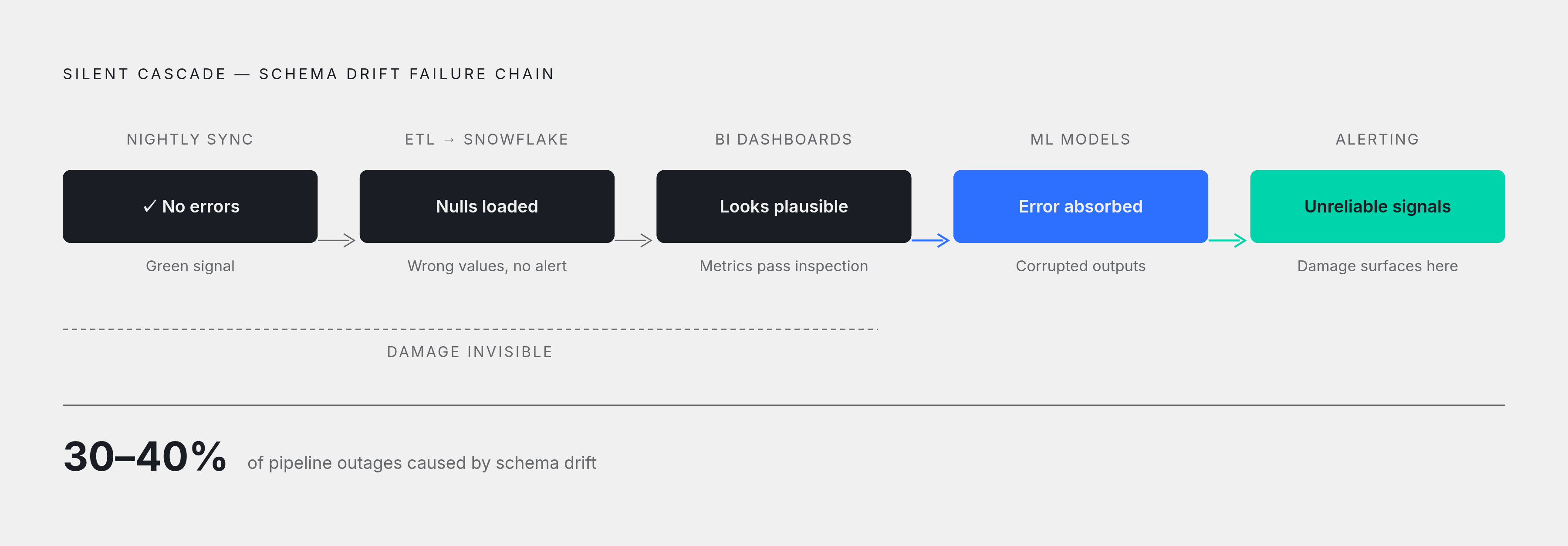
Here is the archetype. A nightly Salesforce-to-Snowflake sync completes with a green checkmark. No errors. No alerts. Three days later, sales ops notices that a revenue field has been null on every new opportunity created since a Salesforce admin renamed a field during a routine sprint cleanup. The sync never failed. The data was just wrong.
From that single mapping failure, here is what happens downstream:
- The ETL job keeps loading records into the destination with nulls or wrong values.
- BI dashboards and reports consume the corrupted destination. The metrics look plausible.
- Downstream ML models trained or scored on the corrupted data absorb the error into their outputs.
- Alerting and monitoring systems that rely on the same field now produce unreliable signals.
In distributed systems, not all components upgrade simultaneously. A producer sending data with a new schema while consumers still expect the old format creates a version mismatch window. During that window, data is either dropped or misrouted.
Industry estimates put schema drift as the cause of somewhere between 30% and 40% of pipeline outages, making it one of the leading structural causes of data infrastructure failure.
A crashed pipeline gets found and fixed. Corrupted data requires forensic work: when did the failure start, exactly which records are affected, and how far back does the remediation need to go.
One more structural problem worth naming: the source system owner who renames a field often has no idea that a separate team owns the ingestion pipeline on the other end. The Salesforce admin renaming a field in a sprint cleanup is not thinking about downstream ETL jobs. There is no communication process connecting those two worlds. That missing handoff is one of the most preventable causes of exactly this failure.
What Early Detection Requires at the Mapping Layer
The core principle is straightforward: schema validation has to happen at ingestion time, before the data lands in the destination. Not after. Catching a problem in the destination means the damage is already done.
There are a few distinct approaches, and they are complementary rather than interchangeable.
Contract testing verifies that the specific interactions a consumer depends on still work after a provider change. Pact-style consumer-driven contracts catch regressions before they reach production. OpenAPI validation tests the full API surface against a specification, catching specification-level breaks that interaction-level contract tests will miss. Both belong in the toolbox.
OpenAPI spec diffing in CI is one of the highest-leverage practices for teams that do not already have it. Running a diff of the upstream API's OpenAPI spec against the last known version, as part of a pull request check, surfaces renames, type changes, and structural changes before deployment. Spec diffs belong in pull requests, not in postmortems.
Schema fingerprinting at the pipeline level catches structural changes even when no error is thrown. Capture a hash or structural snapshot of the API response schema on each run. Compare it to the previous run. Any delta triggers an alert before the data is written to the destination. This is the layer that catches the silent failures: the nulls, the type coercions, the moved paths.
The 2026 systematic review finding that nearly half of behavioral breaking change exceptions lack meaningful error messages is the direct argument for active schema comparison. Passive error monitoring waits for the system to report a problem. With behavioral breaking changes, the system often has no idea anything went wrong. You have to check yourself.
Schema Change Management Requires Infrastructure, Not Vigilance
Here is the math problem. Between 26 and 50 APIs in the average application. Each capable of independent schema evolution. Each with its own versioning conventions, deprecation timelines, and definition of what counts as a breaking change. The number of field mappings to monitor and maintain is not something one engineer can track through careful attention.
Schema change management is estimated to consume more than 24 hours of engineering time per month in manual maintenance. That is time spent reacting to breaks, not building new things. Add in the recurring pattern of multiple data incidents per month, each taking several hours to resolve, and the recurring tax that unmanaged schema drift imposes on engineering capacity becomes very real very fast.
Every integration built against a specific API response structure is a liability that requires ongoing monitoring, maintenance, and periodic remapping. The cost is not one-time. It compounds.
The Stripe model shows one architectural solution: absorb versioning complexity internally, maintain backward compatibility across pinned versions, and shield consumers from the churn. That approach works. It is also an enormous engineering investment that most API vendors do not make, which means the complexity does not disappear. It just gets pushed to the consumer side.
The practical answer is purpose-built infrastructure: schema registries that track and version API contracts, automated diffing that surfaces changes before they hit production, alerting that is attached to schema state rather than just pipeline errors, and governance processes that connect source system owners to the teams maintaining downstream mappings.
Vigilance scales with headcount. Infrastructure scales with the system. At 26 to 50 APIs, you have already passed the point where vigilance is the right answer.