What a Managed Connector Actually Handles vs What You Still Own
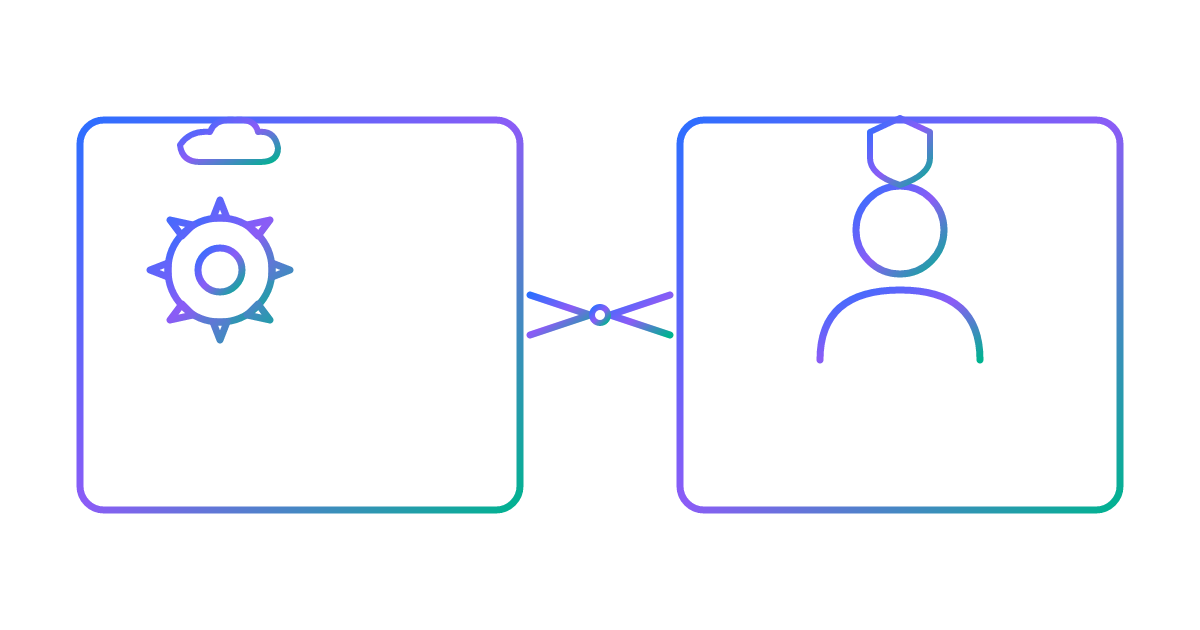
The managed label does not mean infinite flexibility. There are ceilings, and knowing them before you sign off on an estimate is the whole game.
Take schema drift. Automatic handling works cleanly for simple additions. But if a deleted column gets replaced by a new column with the same name, the pipeline fails. A human has to intervene. That means triggering a full refresh or manually dropping the inactive column. The connector cannot sort that out on its own.
The sharpest line in any provider's documentation is the split between known and unknown breaking changes. An unknown breaking change (where a source system quietly changes without any notice) is the provider's problem to fix. A known breaking change (where a vendor announces a deprecation in advance) is explicitly your responsibility to respond to. Fivetran says this plainly in their own docs.
So if a vendor publishes a deprecation roadmap and your team ignores it, you own the resulting outage. The provider is not watching your vendor's changelog for you.
Two other ceilings worth flagging before you get into a project:
Scheduling control is partial. You can choose sync intervals, but exact start times are not configurable. Fivetran manages start times to balance infrastructure load across customers. Your pipeline does not run at precisely 2:00 a.m. just because you typed 2:00 a.m.
The ingestion process itself is sealed. You can configure objects, destination, schedule, and notifications. The ingestion process is not a surface you can customize. That's it.
Teams that assume "managed" means "fully configurable" will hit these walls mid-project. Knowing where the walls are before you start is the difference between an accurate estimate and an optimistic one that quietly becomes someone else's problem.
The Layer That Stays Entirely With Your Team: Transformation and Business Logic
This is the one teams most consistently underscope, and it's not a subtle omission.
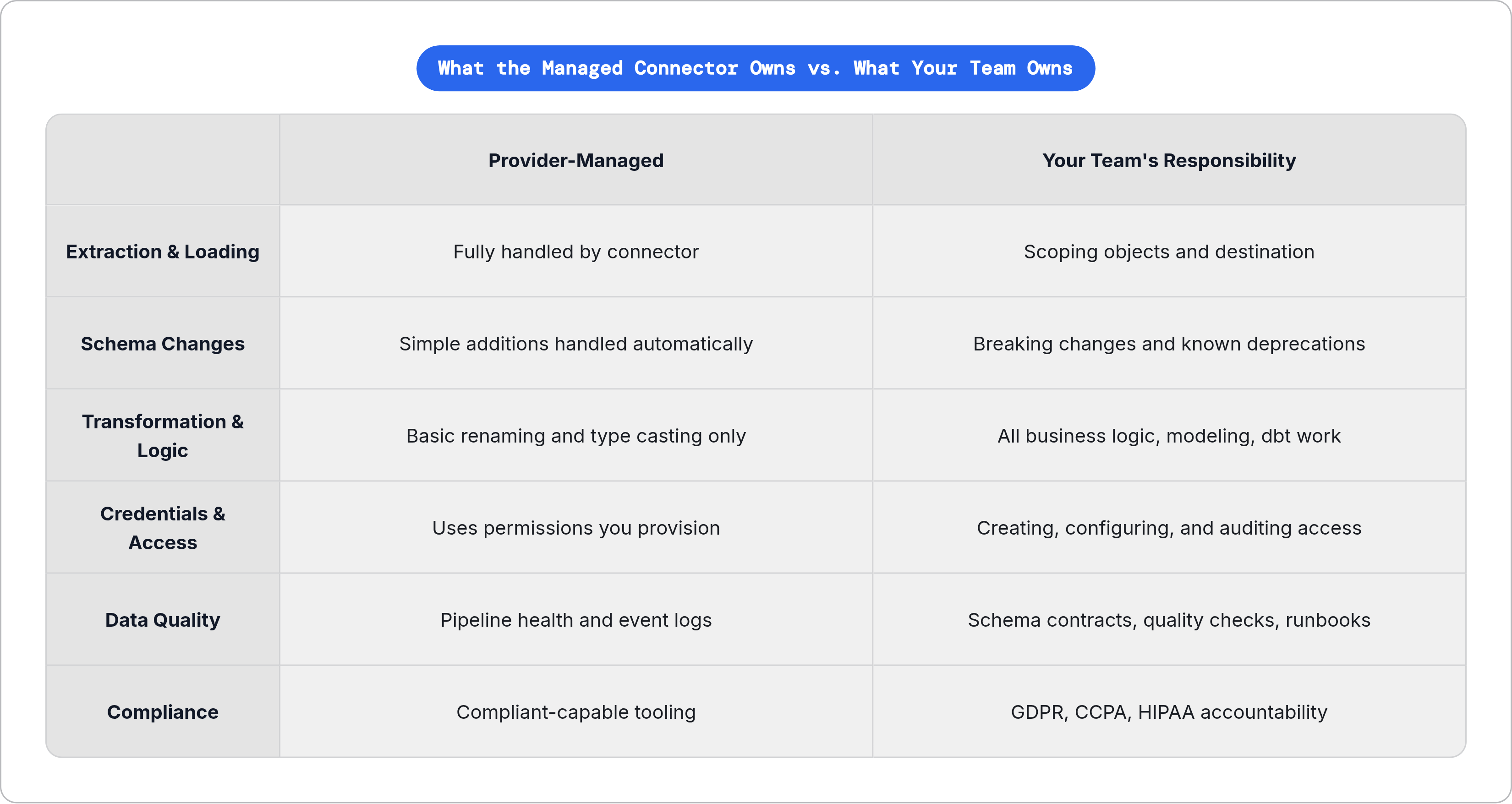
Fivetran says it directly: delivering data in a cleaned, normalized canonical schema at the lowest level of aggregation is their job. Writing the SQL that transforms and models that data into something useful for your specific business is yours. The connector delivers data. It does not interpret it.
Light transformations like column renaming and type casting are included in some connectors. Everything else (business logic, testing, documentation) lives with your team, usually in something like dbt. And as the canonical schema evolves over time, maintaining that transformation layer is ongoing work. Not a one-time setup you forget about after launch.
The practical split for most teams: buy managed connectors for extraction and loading, own the transformation and modeling layer in version control, and treat the warehouse as the system of record. The connector serves the warehouse. It does not replace the work that happens on top of it.
"We are using a managed connector" does not mean "we do not need a transformation engineer." Conflating those two is one of the most common ways integration projects get underscoped. It is also one of the most avoidable.
Credential Provisioning, Access Rights, and Compliance Remain Your Accountability
The connector authenticates using credentials you provision. You create the connection, authenticate your identity, and make sure the service account or API key has the right permissions in the source system. The connector uses those permissions. It does not grant them. Microsoft's documentation on Azure managed connectors spells this out directly.
Misconfiguration, not platform failure, is the dominant failure mode here. Gartner's widely cited projection that 99% of cloud security failures trace back to the customer, almost always through misconfiguration, maps directly onto this layer. You can have a perfectly healthy connector running against a service account with the wrong permissions. The connector fails. The connector gets blamed. The connector is not the problem.
Compliance obligations do not transfer either. Under GDPR, your organization bears primary responsibility as the data controller. Under CCPA, you are the business responsible for consumer data. Under HIPAA, you are the covered entity or business associate. The connector moves data. Knowing where sensitive data lives and how it is being processed is on you. For open-source or self-hosted deployments like Airbyte without a managed designation, that responsibility shifts even further toward your team.
The managed connector is not a compliance solution. It is a compliant-capable tool. Your compliance posture has to wrap around it. Strategic accountability and policy decisions stay internal.
Data Quality Rules and Alerting Thresholds Are Yours to Define
Providers offer real monitoring value. Event logs, cluster logs, pipeline health metrics, and data quality metrics are all available surfaces. That operational visibility comes with the package.
Here is the thing though: a healthy pipeline and a useful pipeline are not the same thing.
Schema drift, null values, and duplicate records can all arrive through a fully-managed connector that is operating exactly as designed. If nobody defined what good data looks like before go-live, a green status light means nothing. Alert thresholds and runbooks need to exist before the pipeline is live, not after the first user complaint. And if you are waiting on user complaints as your feedback mechanism, that was a choice you made by skipping the quality layer.
Three things that need to be in place before you ship:
Schema contracts. Define what you expect incoming data to look like, separately from what the connector will deliver.
Data quality checks on ingestion. Enforce nullability, type, and range rules at the boundary before bad data reaches anything downstream.
Runbooks. Document responses for the failure modes the connector will surface but not resolve.
The provider's monitoring tells you the pipeline ran. Your quality layer tells you whether what arrived was usable. You need both. Only one comes with the subscription.
Not All "Managed" Connectors Carry the Same Level of Provider Commitment
The word "managed" does a lot of work it does not always deserve, and this is where scoping conversations go sideways most often.
Here is a concrete example. As of early May 2025, roughly 15% of Airbyte source connectors carry the "Airbyte Managed" designation and qualify for their 99% uptime SLA. The rest (marketplace and community-contributed connectors) carry no SLA and no guaranteed support. That figure comes from Fivetran's 2025 comparison analysis. The gap between those two populations is not minor.
Fivetran's model extends full support and maintenance to all platform-provided connectors, including hybrid deployments using the same connection code as cloud-hosted instances. That is a materially different commitment level.
Custom connectors sit at the far end of the spectrum. Maintenance and upgrades are fully the customer's responsibility. Support is only available if a premium plan explicitly covers it. When a connector is custom or community-maintained, the following come back to your team without negotiation: API authentication logic, schema change handling, and failure troubleshooting without a vendor runbook.
The right first question when scoping integration work is not "are we using a managed connector?" It is "what tier of management does this specific connector actually carry, and what does the provider's SLA cover?" Those are different questions with very different answers.
How to Use the Boundary Map When Scoping Integration Work
Fivetran's 2026 benchmark report found that data teams spend 53% of engineering time on pipeline maintenance. The managed connector model is built to return that time for higher-value transformation and modeling work. It only delivers on that promise when teams scope accurately, meaning when they account for what the connector absorbs and what still lands on their calendar.
Before any new integration goes forward, work through six questions.
Can your team provision the right access in the source system before work begins? The connector cannot create its own permissions.
Does the source API have any announced breaking changes on the roadmap? Those are your responsibility, not the provider's.
What business logic needs to live on top of the canonical schema? That work does not shrink because extraction is managed.
What does good data look like for each pipeline? Define that before go-live, not after the first downstream failure.
Does the specific connector in use carry a provider SLA, or is it community-maintained? The ownership map is materially different in each case.
Which fields carry regulatory sensitivity, and does your governance layer cover them? The connector moves the data. The compliance posture is yours.
A managed connector shifts operational burden on a specific, well-defined axis: extraction, auth, rate limiting, schema propagation, retry logic. It leaves a parallel axis structurally intact: transformation, governance, quality, and compliance. Accurate scoping means treating both axes together from the start. Assuming the first one eliminates the second is how projects go sideways, and it happens far more often than it should.