How Customers Actually Choose Which Integrations to Prioritize
Most customers prioritize integrations based on existing stack fit, not feature requests.
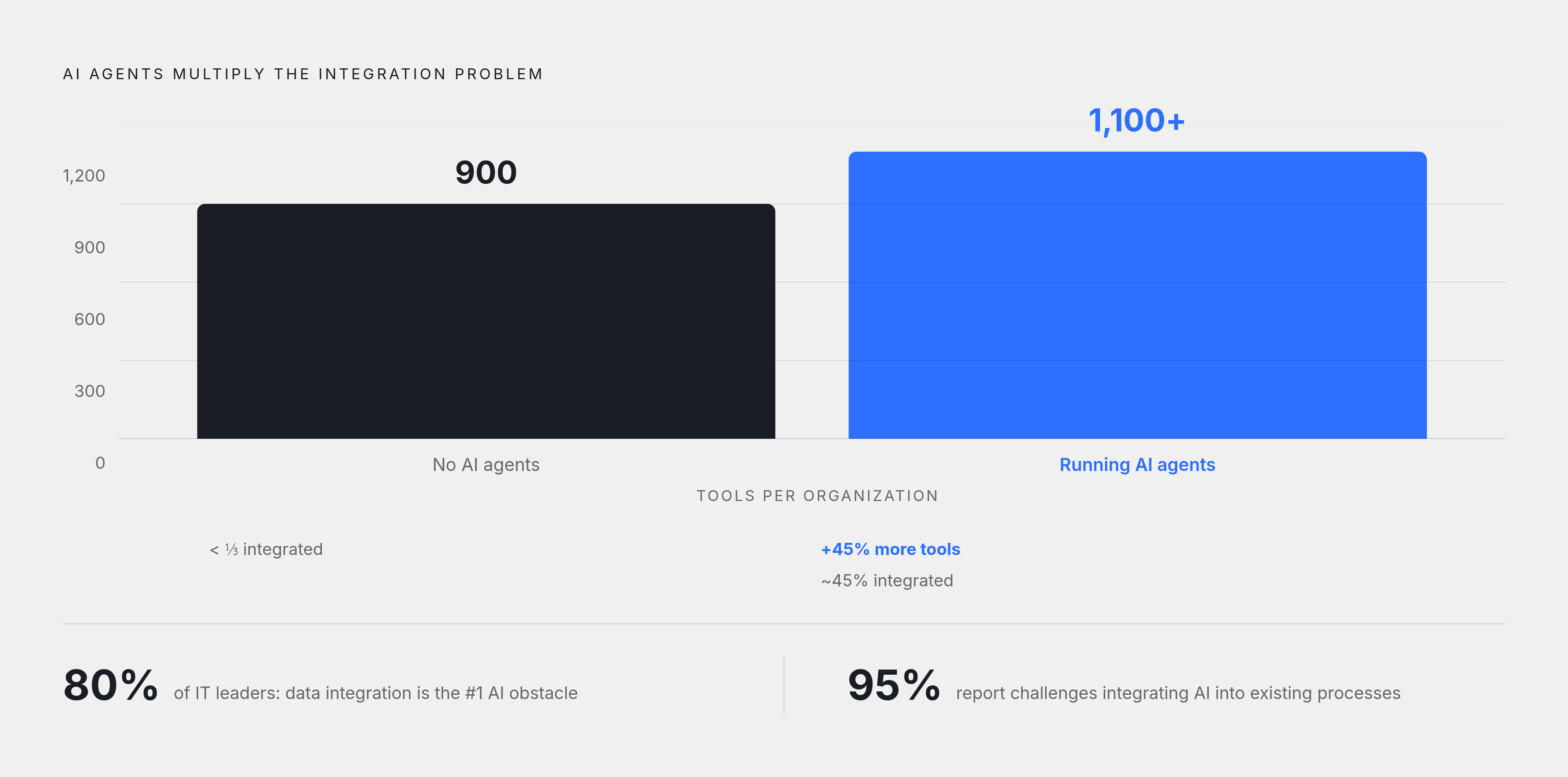
Most software teams are sleepwalking through an operational emergency: the average enterprise runs nearly 900 applications, and less than a third are integrated with anything else. The average enterprise today runs nearly 900 applications. Less than a third of those are integrated with anything else. The rest sit in isolation, connected only by human beings who copy, paste, export, and re-enter data by hand, every single day. Forrester Senior Analyst John Bratincevic has a name for this: "human APIs." People doing what software should do. And here is the thing. AI adoption is making it worse, not better. Organizations running AI agents average over 1,100 tools, roughly 45% more than those without agents. The connectivity gap is widening. The backlog of things that need to talk to each other keeps growing. This is the environment customers are operating in when they decide which integration to ask for next. High stakes. Shrinking attention. A very long list and no clean way to order it.
The customers who figure out the ordering are not guessing. They are following signals. And once you know what those signals are, the whole thing becomes readable.
Integration Has Become a Front-Door Buying Requirement
Start with this number: 39% of buyers named integration with existing software as the single most important factor when choosing a software provider, according to Gartner's 2023 Global Software Buying Trends Report. Not price. Not features. Not support. Integration.
That should feel a little uncomfortable if you are on the product or GTM side of a software company. Most vendors spend the majority of their optimization energy on pricing and feature differentiation. Buyers are already past that conversation. They want to know if the thing connects.
Part of why integration ranks this high is that buying decisions are no longer individual. Gartner puts the share of software purchases involving a team at 83%. G2's 2025 Buyer Behavior Report pegs the typical buying committee at five to eight people. That committee is cross-functional, and integration risk surfaces at every layer of it. IT worries about security and architecture. RevOps worries about data ownership and pipeline hygiene. Finance worries about duplicate systems. Business users worry about whether they will be stuck with another tool that requires manual work to keep in sync.
I watched this play out firsthand on a SaaS team that had built its entire messaging around a VP of Marketing persona. The assumption was solid on paper. But when we actually talked to buyers who had stalled, the real bottleneck was the RevOps leader, who was asking hard questions about stack integration and data flow that the marketing-focused pitch never addressed. Once the messaging was reworked to speak to that concern directly, deals moved faster. The buyer had not changed. We just finally heard the right person in the room.
The downstream cost of getting this wrong is buyer regret. Gartner's 2025 Software Buying Trends Report found that 59% of buyers regret at least one SaaS purchase made in the last 18 months, with many of those regrets tied to integrations that did not perform as expected post-purchase. Customers arrive at the prioritization conversation having already been burned. Their caution is earned.
Workflow Pain Is the Loudest Signal
When customers explain which integration they want prioritized, they almost always start with pain. Specifically, the manual workaround they are doing right now to compensate for the gap. The export. The copy-paste. The spreadsheet sitting between two tools that should be talking directly. That spreadsheet is the canary in the coal mine — small, easy to ignore, and a sign that something underneath is running out of air.
This "integration debt" accumulates quietly. Most growing companies do not notice it until a new tool is added and the workaround volume suddenly spikes and someone is now spending four hours a week doing something a webhook could handle in milliseconds.
A survey of founders identifying customer pain points (Launching Next, October 2025, n=287) found that 26% cited processes, onboarding, or integrations being "messy" as a primary pain category. That is not a niche complaint. That is a loud plurality.
Workflow pain is a reliable signal because it is empirical. Customers can point to it. They can time it. They can tell you how many people touch the process and how often. That specificity is valuable.
But here is the catch. The loudest pain is not always the highest-leverage fix. A manual step that makes one person miserable but only touches two people is far less valuable to solve than a quieter friction point that blocks twenty. So the question is not just "where does it hurt?" It is "how often does this happen, and who does it block?" Frequency and blast radius together tell you whether the pain is worth prioritizing. Frequency alone does not.
Workflow pain tells you where customers hurt. It does not tell you which tool to connect to. That comes from somewhere else.
The Existing Stack Narrows the Decision Faster Than Any Survey
Customers do not choose integrations in a vacuum. They choose integrations with tools they have already committed to, organizationally, contractually, and operationally. The tool is already there. Budgeted. In use. Hard to replace. The integration question is not "should we use this other tool?" The question is "can your product connect to it?"
This creates a structural dynamic that open-ended feature requests often miss. An integration with a tool already embedded in the stack does two things simultaneously. It eliminates the switching cost of replacing the incumbent tool. And it makes your product harder to remove without disrupting other things. Both are strategically important.
This is why stack-fit analysis, mapping which third-party tools appear most frequently across your customer base, often produces cleaner prioritization signals than asking customers what they want. The ask is biased toward what is top of mind. The stack reveals what is actually installed and running.
A practical approach: group integration requests into category buckets. Project management. CRM. Marketing automation. Accounting. Then identify the one or two tools with the largest footprint within each bucket. That is your short list.
Market penetration within your ideal customer profile matters as much as current install base. If a specific CRM or accounting platform is gaining share among the types of customers you are trying to win, future demand is already visible in the trend. You do not have to wait for the requests to pile up.
One concrete example: an outreach product prioritized integrations with HubSpot and Zoho CRM not because those were the flashiest options but because they removed the manual lead-export step that was blocking sales rep adoption. The integration's value was not new capability. It was frictionless activation. The reps just started using the product because it was no longer annoying to connect.
The real question is not "what do customers ask for?" It is "what is already woven into how they work?"
When a Missing Integration Becomes a Deal-Blocker or a Churn Trigger
Some integration gaps do not surface as friction. They surface as a lost deal or a cancellation conversation. That is a different kind of forcing function. And it requires a different kind of response.
Userpilot research on real-world churn patterns identifies customers who never adopted sticky features or integrations as one of the most frequent sources of preventable churn. The product was there. The connection was not made. The customer left. That sequence is frustratingly common.
On the other end of the spectrum: infrastructure SaaS, the most integration-dependent software category, has the lowest monthly churn, sitting at just 1.8%. That number is not an accident. Deep technical integration and mission-critical dependencies make replacement disruptive and expensive. The integration is the retention mechanism.
When a prospect tells sales they will not sign without a specific integration, the reactive instinct is to figure out how fast you can build it. The better instinct is to ask three questions first. Is this customer or prospect aligned with your ideal customer profile? Are other current customers or prospects using the same tool? And can it be delivered without delaying higher-priority work? Those three questions convert a reactive pressure into a structured decision.
The trap is building to keep a single non-ICP customer. It feels like a win. It rarely is. The integration request is only worth expediting if it signals broader demand.
Prospect data deserves just as much weight as customer data here. If a meaningful share of prospects mention the same tool during sales conversations, that is a leading indicator before churn ever becomes the forcing function. Pay attention early.
Security and Compliance Requirements Sort the List for Regulated Buyers
In regulated industries, healthcare, financial services, legal, government, the integration prioritization conversation runs through a compliance filter before anything else applies. Workflow pain is irrelevant if the integration cannot clear security review. Stack fit is irrelevant if the third-party tool does not meet data residency requirements. The compliance question comes first.
Buyers in these segments are looking for specific things. Relevant certifications. Data residency controls. Real-time audit logging. Clear documentation of how sensitive data is handled in transit between systems. If those boxes are not checked, the conversation ends there, regardless of how technically impressive the integration is or how much time it would save.
This creates a structural effect on prioritization. Integrations with tools that have already cleared compliance reviews at peer organizations carry lower perceived risk. They come with a shorter internal review cycle. They are practically easier to greenlight, even if they are not the most requested option.
For product teams serving regulated segments, the compliance posture of the third-party tool is a co-equal input to the prioritization decision. It is not a post-decision detail. You can build a technically excellent integration that never gets used because the tool it connects to cannot survive procurement.
AI Adoption Is Creating a New Tier of Integration Requirements
AI is not just another tool category. It is changing what enterprise buyers treat as baseline connectivity. And the numbers behind this shift are striking.
MuleSoft's 2026 Connectivity Benchmark Report, drawing on over 1,000 IT leaders, found that 95% of organizations report challenges integrating AI into existing processes, and 80% cite data integration as the most significant obstacle. The same report found that 96% of IT leaders agree that the success of AI agents depends heavily on seamless, debt-free data integration.
Gartner projects that 40% of enterprise applications will integrate task-specific AI agents by the end of 2026, up from less than 5% in 2025. That ramp is fast. And it is already changing buyer behavior. Enterprise buyers are now asking AI architecture questions during procurement, not just during IT review. Integration capability with AI pipelines is entering the front-end buying checklist.
The painful irony: organizations racing to adopt AI tooling are creating new data silos in the process. They are resolving old ones at a slower rate than new ones appear. The integration priority list is getting longer, not shorter. Per MuleSoft's 2025 research, organizations running AI agents average 45% more applications than those without them. More tools. More connectivity gaps. More human APIs filling in the spaces between.
For prioritization decisions, this means integrations that unlock AI workflows, data pipelines, model inputs, agent actions, are being elevated in customer priority lists independent of traditional workflow-pain signals. A customer may not be able to articulate the pain yet because the AI stack is still being assembled. But the demand is coming, and it is arriving faster than most integration roadmaps are prepared for.
The Frameworks That Impose Order on a Very Long List
Three recurring prioritization strategies show up across product teams: which integrations are most needed by current customers, which extend product functionality and addressable market, and which increase competitive advantage. Most teams need to weigh all three simultaneously. The challenge is doing that without the process collapsing into whoever spoke loudest at the last meeting.
A few frameworks that actually get used:
- Effort-Impact Matrix. Plot each integration on a 2x2 of effort versus customer impact. High-impact, low-effort gets built first. Simple and fast to run.
- RICE Scoring. Reach, Impact, Confidence, Effort. Developed by Intercom. Allows quantitative comparison of integration requests against each other. More work to set up, but it produces a defensible rank order.
- MoSCoW. Must Have, Should Have, Could Have, Won't Have. Useful specifically for aligning a cross-functional buying committee with competing priorities. Less precise, but excellent for getting cross-team agreement.
The ICP filter is the override on all of them. Frameworks produce scores, but scores need to be filtered against your ideal customer profile. One-off requests from non-ICP customers can dominate a RICE score if reach is miscounted. The output is only as clean as the input.
Before scoring anything, run an integration debt audit. Map how data currently moves between systems, manually, via spreadsheet, via existing API. That map surfaces the gaps the framework needs to address. Scoring before mapping means you are ranking solutions to problems you have not fully described.
Two practical traps to avoid.
The first is "snacking." Without a scoring framework, decisions default to the loudest voice or the most recent complaint. This is how teams end up shipping low-impact integrations while high-leverage ones sit on the backlog for a year.
The second is over-engineering latency. Customers often overestimate how much real-time data sync they actually need. Real-time integration is expensive and complex. Many use cases run perfectly well on hourly or daily sync. Pushing the real-time versus batch question into the prioritization process, before you start building, prevents a lot of avoidable complexity downstream.
Integration Depth Is the Strongest Retention Mechanism You Have
Here is the piece that ties everything together. Integration depth is the strongest structural predictor of whether a product survives long-term in a customer's stack. Not NPS. Not customer success coverage. Integration depth.
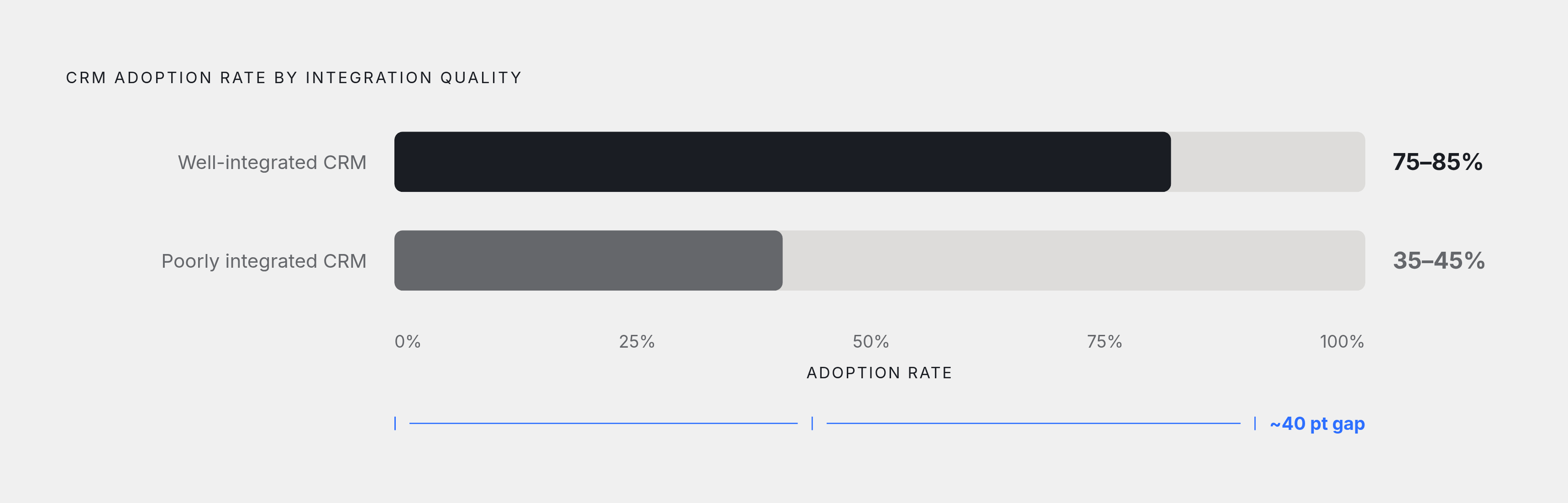
The adoption data on CRM systems makes this concrete. Well-integrated CRM systems see adoption rates in the 75 to 85% range. Poorly integrated systems sit at 35 to 45%. That gap is not marginal. It is the difference between a product that is used and a product that gets cancelled at renewal.
Infrastructure SaaS at 1.8% monthly churn and HR and back-office SaaS maintaining growth despite higher churn rates both reflect the same underlying mechanism. Deep integration into payroll, benefits, or core operations makes the switching cost organizationally prohibitive. Nobody cancels the thing that touches everything else. Not because they signed a contract. Because removal means unwinding a data and workflow dependency that the entire team has built around.
Each integration a customer configures adds to that dependency structure. The compounding effect is real. The first integration makes the product useful. The second makes it harder to remove. The third makes it hard to imagine replacing. None of that is manipulation. It is just what happens when software is genuinely woven into how people work.
This reframes the entire prioritization decision. Choosing which integration to build first is not just about closing the next deal. It is about which integration will most deeply embed the product into the workflows customers will not want to disrupt.
The customers who prioritize integrations well are following consistent signals in a consistent order: where friction is densest, what is already in the stack, what is blocking deals, what the compliance environment requires, and where AI pipelines are being built. Product teams that read those same signals in the same order build the integrations that compound. The ones that do not end up building whatever was loudest last quarter and wondering why churn is still climbing.