What Security Teams Actually Scrutinize in a Third-Party API Integration
If you've been paying attention to breach reports lately, the perimeter has moved. It's not your firewall anymore; it's your vendors. Think of the modern enterprise as a castle that spent years reinforcing its walls, only to discover that the real threat was walking in through the front gate with a vendor badge. In 2024, 35.5% of all recorded breaches were tied to third-party vulnerabilities. APIs are where that exposure concentrates. Breaches linked to APIs averaged $4.88 million per incident in 2024. Fifty-seven percent of organizations suffered an API-related breach in the past two years, according to Traceable AI's 2025 State of API Security Report. And 38% of data leaks trace specifically to third-party API integrations. This is not a niche problem; it is the problem. Security teams know this. That's why, when a developer shows up asking to wire in a new third-party API, the review that follows is thorough, structured, and sometimes painfully slow. Over 55% of organizations say API security concerns are already slowing software rollouts. So the friction is real, and it has product consequences. But here's the thing: the questions security teams ask are predictable. Every section of this piece maps one of those questions to the failure mode behind it. Know the questions in advance, and you stop being reactive. You show up prepared.
How Security Teams Frame the Review Before Looking at a Single Line of Code
Security teams don't start by reading your code. They start by asking whether your vendor deserves to be trusted at all. An integration isn't just a technical deployment to them; it's a third-party risk event. The vendor relationship gets evaluated first. The endpoints come second.
Most reviews follow a two-phase structure. Phase one: due diligence on the vendor. Phase two: technical scrutiny of the integration itself. What determines how deep phase one goes? Three things.
- Data sensitivity. Does this integration touch PII, financial data, or health records? The more sensitive the data, the harder the look.
- Blast radius. How many internal systems or users does this integration reach? A narrow, scoped integration gets more latitude than one that touches half the org.
- Vendor maturity. Is this a known entity with published security documentation, or a startup with a landing page and no audit history?
The checklist isn't bureaucratic noise. Every item on it maps to a real failure mode. The sections that follow trace exactly that mapping. Read them with the reviewer's lens in mind, and the logic becomes obvious fast.
What Vendor Certifications and Documentation Security Teams Ask for First
Before anyone looks at an endpoint, certain documents need to exist. If they don't, the conversation stops there.
Here's what gets requested:
- SOC 2 Type II or ISO 27001 certification. Independent audit, not the vendor's word for it. Self-attestation doesn't count.
- Recent penetration test results. Not ancient history. Recent.
- Business continuity and disaster recovery plan. What happens when something breaks?
- Vulnerability disclosure program or bug bounty. This one signals something important: does the vendor treat security as ongoing work, or did they check a box once and move on?
Contractual review runs alongside this. Security teams are looking at:
- SLA provisions. What uptime is guaranteed, and what remedies exist when it falls short?
- Notification obligations. Is the vendor contractually required to tell you if a token is compromised or a breach occurs?
- Specific OAuth security requirements written into the agreement. Yes, this is happening. Goodwin Law's 2025 guidance flags it as a growing contractual standard.
One more thing: due diligence isn't a one-time event. Reviewers assess not just whether the vendor can produce documentation now, but whether the organization has a plan to re-evaluate periodically. The review cadence is part of the review.
For developers, the practical takeaway is simple. Come to review with this documentation in hand, or know for certain the vendor can produce it on short notice. That alone compresses timelines significantly.
Authentication Mechanisms and Where Reviewers Focus Their Technical Scrutiny
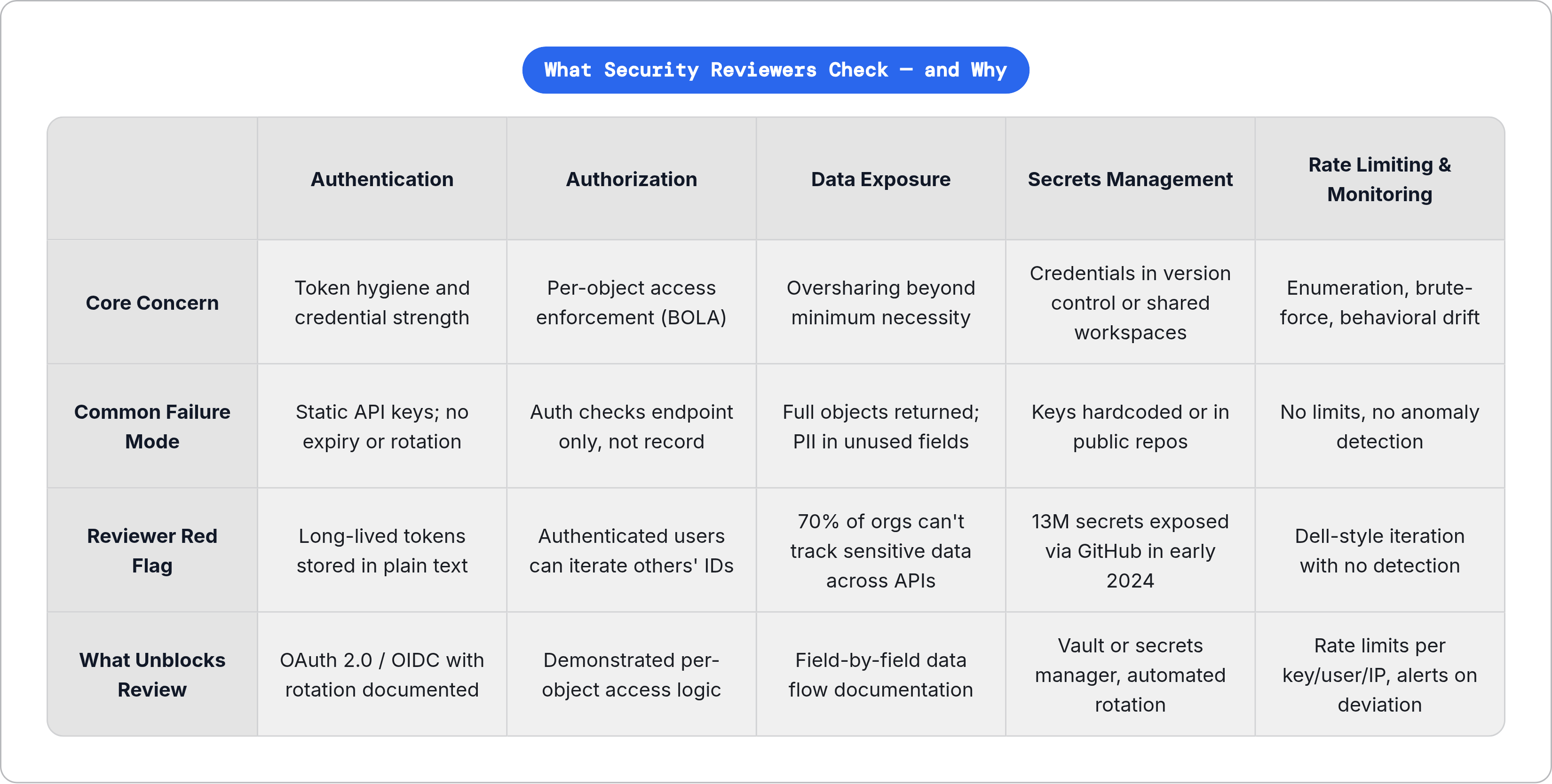
The baseline expectation for any modern integration is support for OAuth 2.0, OpenID Connect, or JWT. API keys alone don't cut it for SaaS, fintech, healthcare, or AI workflows. Not anymore.
Why? Because API keys identify an application, not a user. They carry no contextual risk signal. They frequently lack expiry, rotation, and scope constraints. There's no mechanism for behavioral monitoring or step-up challenges; they're static credentials in a world that's moved past static credentials. Relying on a bare API key for security is like locking your front door but leaving every window wide open — the lock looks right, but it isn't doing the job.
A 2025 Gartner report found that 34% of API breaches involve authentication bypass. That's the second most common root cause, behind only authorization failures.
Token hygiene is where reviewers dig in specifically:
- Do tokens expire? Is rotation supported and actually enforced?
- Are long-lived tokens stored in plain text anywhere in the stack?
- If the answer to that last one is yes, that's a blocker.
Salt Security's 2025 research found that 95% of API attacks originate from authenticated sources, meaning stolen keys and tokens, not unauthenticated probes. The attacker already has a credential. The question is whether that credential was managed well enough to limit the damage.
In regulated environments, mTLS is the bar. Bidirectional certificate authentication. Both the client and the server present certificates. This is mandatory in zero-trust models, and reviewers in those environments aren't treating it as optional.
The 2025 Salesloft-Drift OAuth supply chain incident is the recent case study that reviewers have in the back of their minds. Compromised third-party OAuth tokens gave attackers access to hundreds of downstream environments. Obsidian researchers found the blast radius was ten times greater than prior incidents of direct Salesforce infiltration. Authentication hygiene isn't abstract; that incident made it very concrete.
OAuth Scope Creep and Why Over-Permissioned Integrations Fail Review
Over-scoping is a structural default, not a developer character flaw. The incentives push toward it. Developers request broad permissions to avoid coming back later for more. Users approve permission dialogs without reading them. "Full access" persists indefinitely unless someone explicitly goes back and revokes it. Nobody does that.
Security reviewers know this pattern. They look for minimum viable scopes, not convenience scopes. The question isn't "what did the developer request?" It's "what does the workflow actually require, and does the permission footprint match that?"
Red flags reviewers flag immediately:
- Write access granted when the integration only needs to read data
- Scopes that span organizational data when the use case is single-user
- No documented justification for why each scope was requested
Analysis published in 2025 by researcher Kevin Qiu confirmed that SaaS vendors still commonly request excessive permissions and store long-lived tokens in plain text. This isn't a fixed problem; it's still the default behavior in a lot of ecosystems.
The specific deliverable that tends to unblock review: a scope inventory. A written map of what each permission does and why it's required. It sounds simple. It often isn't, because the developer has to be able to defend every line of it. But showing up with one signals that the integration was designed intentionally, not just wired together until it worked.
Authorization Gaps and What BOLA Means in a Real Integration Review
BOLA stands for Broken Object Level Authorization. Here's what it means in plain terms: the API checks whether you're authenticated, but it doesn't check whether you're allowed to access the specific record you're asking for. You're logged in. The door's open. But the API doesn't verify that this particular file belongs to you. It's a bouncer who checks your ID at the door but never asks which table you're sitting at — authenticated, yes; authorized, not quite.
It's endemic for a structural reason. Authorization logic lives in application code, not the API layer. It's easy to miss in development, and it's easy to miss in review. Injection attacks and BOLA together made up more than a third of all API security incidents in Q1 2025.
What reviewers look for specifically:
- Does the API enforce access checks per object, not just per endpoint?
- Can an authenticated user enumerate or access records belonging to other users just by manipulating an ID in the request?
- Are internal object IDs exposed in responses? If so, why?
That last one matters because BOLA and excessive data return are often the same vulnerability wearing different labels. The API returns the full object when it should return only what the caller is authorized to see. The attacker gets object IDs. They iterate through them. They pull records that aren't theirs. That's the pattern.
Data Minimization and the Exposure That Comes from APIs Returning Too Much
The core question here is straightforward: does the integration share only the minimum data necessary to do its job? In practice, the answer is often no, and security teams know it.
Seventy percent of organizations admit they cannot fully track sensitive data across APIs. Reviewers go into data flow documentation skeptical, not credulous.
CSA's 2025 SaaS security benchmark put numbers to the problem. Sixty-three percent of organizations reported external data oversharing. Fifty-six percent said employees upload sensitive data to unauthorized SaaS apps. Fifty-eight percent struggled to enforce access privileges. These aren't edge cases; they're the norm.
The technical pattern reviewers flag: APIs that return full objects, including fields the caller never requested, when a filtered or scoped response would be sufficient. Every extra field is surface area. Every extra field containing PII is a potential exposure event.
What developers can do to get ahead of this:
- Document exactly which fields are transmitted and why each one is necessary
- Confirm that no PII or internal identifiers appear in responses unless the use case explicitly requires them
Showing up with that documentation doesn't just answer the reviewer's question. It demonstrates that the integration was built with this question in mind.
Encryption Requirements Reviewers Apply to Data in Transit and at Rest
This section is shorter than others because the standards are less ambiguous. TLS 1.3 or stronger is the current baseline for data in transit. Older TLS versions get flagged. APIs lacking encryption expose sensitive data in transit in over 12% of cases, and reviewers treat any unencrypted endpoint touching sensitive data as a hard blocker.
For data at rest, AES-256 is the expected standard. Reviewers look for vendor documentation that explicitly confirms this. Not implied. Confirmed.
In regulated environments, mTLS applies here too. Both the client and the server present certificates. It's not optional in zero-trust architectures.
The practical item developers can act on immediately: can you produce vendor documentation confirming these standards? A security page, a shared responsibility document, a completed security questionnaire. Absence of documentation is itself a flag; reviewers don't assume that because the API exists and works, it's encrypted properly.
How Secrets Management Failures Expose Integrations Before They're Ever Attacked
Here's a number that should make any developer uncomfortable. In March 2024, nearly 13 million API secrets were exposed through public GitHub repositories. In the same period, researchers found 18,000 API secrets and tokens floating on the open web. Separately, 30,000 Postman workspaces were found exposed, containing live API keys, access tokens, and sensitive payloads including healthcare records, because developers saved real credentials in shared workspaces without access controls.
These integrations were exposed before anyone ever attacked them. The breach was already done.
What reviewers look for:
- Are API keys stored in environment variables or a dedicated secrets manager (HashiCorp Vault, AWS Secrets Manager, Azure Key Vault)?
- Is there any evidence of credentials in version control history, including deleted files?
- Is automated rotation in place, with rotation intervals documented?
A practice emerging among CISOs, per CSO Online's 2025 reporting: centralize all third-party credentials within the API management layer. Raw credentials never get distributed to individual developers. The secret lives in one place, rotates on a schedule, and access to it is auditable.
For developers, the secrets management question is one of the fastest to answer definitively in a review. "Yes, we use Vault, rotation is automated, no credentials are in version control." Done. It's also one of the most common reasons integrations stall when the answer is unclear or absent.
Rate Limiting and the Abuse Controls That Reviews Treat as Non-Negotiable
Dell's 2024 breach is the example that lives in every rate limiting conversation now. A single partner API endpoint with no rate limiting, no behavioral monitoring, and no validation. An attacker iterated random service tags and scraped tens of millions of customer records. No sophistication required. Just iteration.
That's what absence of this control produces.
Rate limiting prevents:
- Brute-force and credential stuffing against authenticated endpoints
- Enumeration attacks, which is exactly the Dell pattern
- Denial-of-service from misbehaving clients, whether malicious or just broken
Forty-six percent of all account takeover attacks targeted API endpoints. That figure makes rate limiting on authentication endpoints a specific reviewer priority, not a general best practice.
Review questions in this area:
- Is rate limiting applied per API key, per user, per IP, or some combination?
- Are responses to exceeded limits generic (the standard 429 response) or do they leak internal details?
- Is anomaly detection in place? Does the API flag unusual call volumes or access patterns before they become an incident?
If the answer to that last one is "we don't know," that's the answer the review documents.
Logging, Monitoring, and Why Behavioral Drift Triggers a Security Response
Only a small fraction of organizations report a high ability to detect API attacks, according to Traceable AI's 2025 research. Reviewers know this; they treat monitoring capability as a differentiator, not a baseline assumption.
What gets checked:
- Does the API provide audit logs? Are those logs accessible to the integrating team, or do they live only on the vendor's side?
- Are access events logged with enough detail to support an actual incident investigation? Token use, data reads, permission changes. The specifics matter.
The behavioral drift standard is what separates mature security teams from the rest. CISOs quoted in CSO Online's 2025 reporting put it plainly: if an integration begins acting outside its expected pattern, it's treated as a security event, not a technical anomaly. Credentials get scoped, rotated, and actively watched for drift.
What developers can do to pre-empt the scrutiny:
- Document the integration's expected call patterns
- Confirm that alerts exist for deviations from those patterns
- Know the log retention period and confirm it aligns with the organization's incident response requirements
Showing up without this is showing up without a monitoring plan. Reviewers notice.
The Maintenance Burden Security Teams Weigh When Deciding Whether to Approve an Integration Long-Term
Approval at launch isn't the finish line. Reviewers know they're not just evaluating a snapshot; they're committing the organization to an ongoing relationship with that integration and that vendor. So they assess the maintenance picture at the initial review.
What they're weighing:
- API versioning and deprecation. What happens when the vendor drops a version? Who owns the update? Is there a documented process, or does this become a scramble when it happens?
- Re-review triggers. Material changes to data handling, new scopes being added, vendor ownership changes. These should automatically trigger a fresh look. Does the organization have a policy that says so?
- Periodic re-evaluation. Not just when something changes, but on a regular cadence. The vendor that passed review two years ago may have had a change in leadership, a data incident, or a shift in their security posture.
Organizations now average 131 third-party APIs, up from 127 the prior year. The review burden scales with that number. Security teams are asking, implicitly, whether approving this integration adds sustainable overhead or creates a maintenance debt that nobody will pay.
The developer who comes to review with a clear answer to these questions. Who owns updates when the vendor deprecates an endpoint? What's the re-review trigger? That developer is not just getting the integration approved; they're making the security team's job easier for the life of the integration. And that changes the relationship from adversarial to collaborative, which, honestly, is where both sides want to be anyway.