What Happens to Your Integration When a Third-Party Changes Its Auth Flow
Silent auth changes break integrations differently—know the category to fix it faster.
Auth changes don't announce themselves with a dramatic crash. Half the time, something just quietly stops working — like a smoke alarm that only goes off after you've already eaten the burnt toast. According to the 2024 State of the API report, 52% of developers hit a production crash from an unannounced third-party breaking change that year. Average API uptime dropped measurably between Q1 2024 and Q1 2025. And when you dig into where monitoring errors actually come from, API failures, HTTP errors, timeouts, and TLS issues account for the majority. Auth is almost always the first place to look.
The thing is, these aren't random events. They cluster around specific trigger types. And once you know the trigger types, the failure modes stop feeling like surprises.
The three categories of auth flow change that cause integrations to break
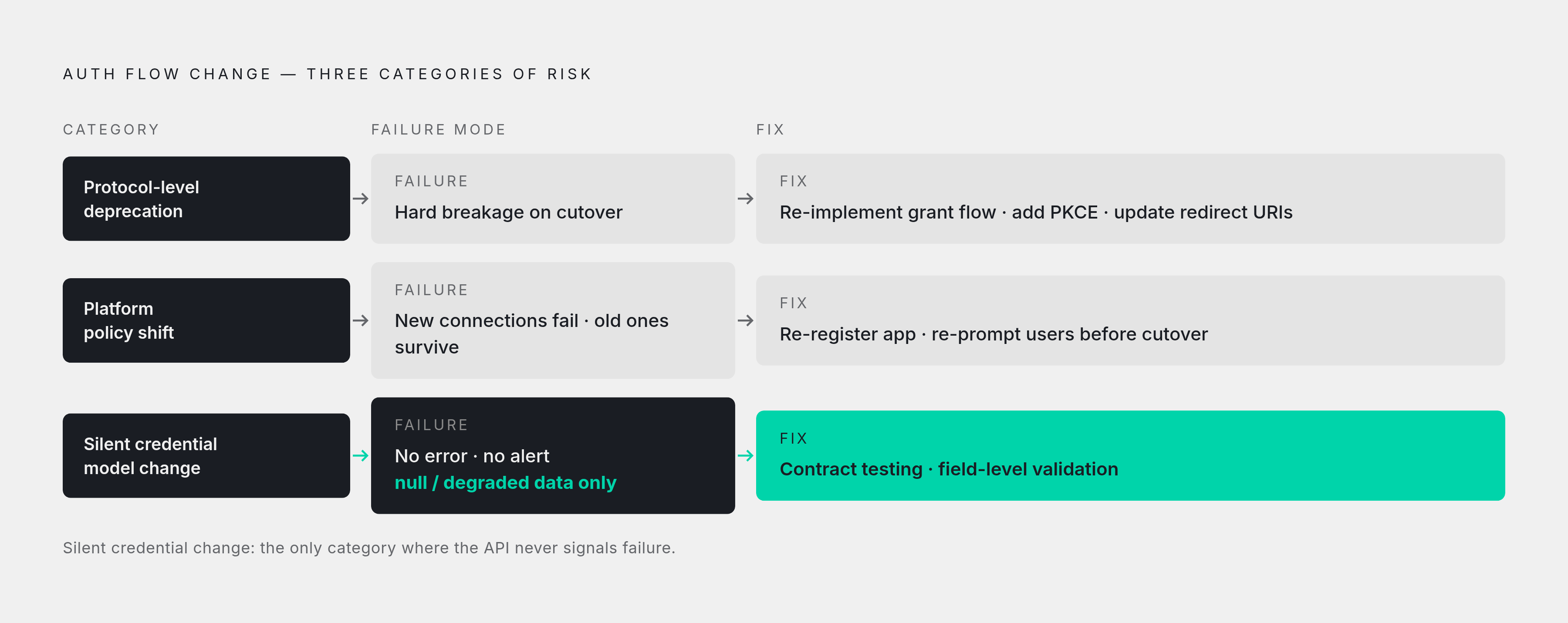
Not all auth changes are the same. This is the part most teams skip, and it's why their response is almost always slower than it needs to be. The category of change determines the failure mode. The failure mode determines the fix. If you misdiagnose the category, you're solving the wrong problem.
There are three categories worth knowing:
Protocol-level deprecation. This is when a standards body retires a grant type or flow. The IETF publishes the change. Major identity providers enforce it on a timeline. That timeline will or will not match yours. This is the least surprising category in theory, and somehow still the most disruptive in practice.
Platform policy shifts. A single vendor decides to restrict, monetize, or restructure how third-party apps authenticate. No IETF involvement. No warning standard. No heads-up from anyone except, if you're lucky, a changelog post you probably didn't see. These are unilateral decisions, and they hit fast.
Silent credential model changes. This is the sneaky one. The underlying token shape, scope, or expiry behavior changes without a hard cutover. Old tokens still work. Until they don't. There's no error. There's no alert. Just a workflow that silently degrades until someone notices the data is wrong.
Why does the category matter so much? Because the recovery path is completely different for each one. Protocol deprecation means you're re-implementing a grant flow. A platform policy shift requires re-registering an app or prompting users to re-authorize. A silent model change means you need contract testing and field-level validation, because the API will never tell you something broke.
What OAuth 2.1 actually removes and which integrations are in the path
OAuth 2.1 is still a draft spec (draft-ietf-oauth-v2-1-15 as of early 2026), but that doesn't mean it's theoretical. Major identity providers are already treating it as the standard. Auth0, Okta, Google, and Microsoft have all either deprecated legacy flows or published enforcement timelines. Newer providers like Curity, Ory, Descope, Zitadel, and Stytch ship strict OAuth 2.1 compliance by default.
Here's what actually got removed, and why each one matters:
Implicit grant is gone. This was the flow where a token came back directly in the URL fragment. That means it showed up in browser history, Referer headers, and server logs. It was the default recommendation for single-page apps in older OAuth 2.0 documentation. If an integration was built more than four years ago against docs that said "use implicit for SPAs," assume it's using implicit until you verify otherwise.
ROPC is gone. Resource Owner Password Credentials is the flow where an app collected the user's username and password directly and exchanged them for a token. It sounds obviously bad when you say it out loud. It was still widely used in legacy CLI tools, first-party mobile apps, test harnesses, and server-side passthrough login. More common in existing integrations than most teams want to admit.
PKCE is now required for all clients. Previously optional for confidential clients. Now mandatory. This one is relatively easy to add, but it does require a code change.
Refresh token rotation is mandatory. Single-use refresh tokens only. If your integration holds onto a refresh token and reuses it across multiple requests, that's a silent failure waiting to happen. You won't get an immediate error. The token will stop working at some unpredictable future point.
Exact redirect URI matching is enforced. Wildcards are rejected. This catches more integrations than people expect, especially older ones that used broad URI patterns to handle multiple environments.
Auth0 deprecated third-party application enhanced security controls in April 2026, with end-of-life set for October 23, 2026. If you're on Auth0 and haven't audited your connected apps recently, that date is real.
The practical read here: if a customer's integration was built several years ago following OAuth 2.0 documentation, assume implicit or ROPC until proven otherwise. That assumption will save you time.
Platform-specific changes that broke integrations regardless of the spec
This is where things get interesting. These changes didn't come from the IETF. They came from individual vendors making product decisions, sometimes following a security incident, sometimes following a business model shift.
Salesforce (September 2025). Salesforce eliminated OAuth Device Flow entirely on September 2, 2025 and blocked uninstalled Connected Apps for most users. New connections started failing with OAUTHAPPBLOCKED or OAUTHAPPROVALERROR_GENERIC. The catch: existing connections made before the cutoff were unaffected. That made this an asymmetric breakage. It only appeared during new customer onboarding, which is exactly when you least want your auth flow to fail. The policy change followed over 700 Salesforce org compromises in 2025, including a supply chain breach involving Salesloft and Drift.
Twitter/X (2023 to 2025). Free API access ended in February 2023. The platform shifted to pay-per-use, required third-party tools to remove personal API keys from their systems, and effectively shut down hundreds of thousands of integrations. Many apps simply stopped working. Some shut down entirely.
Google IAP (January 2025). Google deprecated the Identity-Aware Proxy OAuth 2.0 Admin API. Scripts and Terraform configs automating IAP client or brand resources broke when the API was fully shut down in July 2025. Infrastructure-as-code is particularly vulnerable here, because it's easy to forget that an API call buried in a Terraform module is still an API call.
HubSpot OAuth v1 (sunset February 16, 2027). Calls to v1 endpoints will return errors after that date. HubSpot moved to date-based versioning with an 18-month support window and fixed release cadence. That's actually a better model than most. But it only helps if you're watching.
Atlassian/Jira. OAuth 1.0a is fully deprecated. Marketplace partners were instructed to stop collecting or storing Atlassian API tokens and migrate to Forge or OAuth 2.0 with 3LO.
SAP SuccessFactors. SOAP-based Employee Central APIs reached end of maintenance in May 2024 and were deleted in May 2025. An SSO certificate expired June 2025, requiring migration to SAP Cloud Identity Services. Certificate expiry is a particularly brutal failure mode because it produces a hard stop, not a graceful degradation.
HiBob. The API Access Token method was shut off completely. The Service User method became the only supported path, with a transition window that closed in late 2024.
Every one of these had a published date. The integration-side work, which means re-registering apps, updating credentials, re-prompting users, had to be done before that date. Not after. The deadline is the deadline.
Token lifecycle changes that fail without ever returning an error
Token expiry is already a mess. Xero access tokens expire after 30 minutes. QuickBooks Online after 60 minutes. Intuit moved to daily refresh token rotation in late 2025. Sage Intacct uses a session-based model that doesn't follow standard REST token conventions at all. Every provider handles this differently, and none of them are wrong exactly. They're just different in ways that require you to handle each one explicitly.
Here's the failure pattern that kills teams:
A token expires or gets revoked. The API returns a 401. If retry and re-auth logic isn't already in place, the workflow stops processing. But the service keeps running. It looks operational. No alert fires. Nobody knows until a user notices the data is stale, or worse, until it never comes up at all because nobody was expecting that data in the first place.
Background automation is especially vulnerable here. No user is watching when the failure happens. The job runs, the token is rejected, the job silently stops, and nothing surfaces until a human goes looking. It's like a mousetrap that springs in an empty room — technically it worked, but nobody's there to see it.
Provider-enforced revocation adds another layer. OAuth providers can invalidate tokens after detecting suspicious activity or following a security incident. Employee offboarding, permission changes, and account lifecycle events can all revoke tokens that were working perfectly fine, without touching the integration itself.
The Harvest example is a good one to have in your back pocket. In early 2024, Harvest renamed a field: client.name became client.display_name. Both fields coexisted temporarily. No error was thrown. Teams got empty strings flowing into reporting tables for weeks. No 400. No alert. Just null data.
A 2025 HubSpot incident makes a different but equally important point. A Microsoft outage caused HubSpot to misclassify recoverable Outlook sync failures as permanent authentication errors, disconnecting inboxes. The lesson there is that error classification logic is itself a failure surface. Getting the classification wrong produced a worse outcome than the original failure would have.
One more number worth taking seriously: according to Entro Security's 2025 State of NHIs and Secrets in Cybersecurity, 44% of non-human identity tokens are exposed in the wild across tools like Teams, Jira, Confluence, and code commits. Long-lived refresh tokens are the specific risk vector. They operate independently of SSO and MFA controls, which means a compromised refresh token is a problem that doesn't get caught by your standard security tooling.
Why catching changes early depends on how vendors communicate them
The best-practice signals for deprecation are well-defined and easy to name. Deprecation and Sunset HTTP response headers. A Link header pointing to the successor version. Email to active OAuth app maintainers. In-product banners. These aren't hard to implement. Some vendors do them well.
GitHub does this right. Roughly 12 months of notice. Changes marked in both the REST API and GraphQL schema. Emails sent to active maintainers. Sunset and Deprecation headers in responses. You have to actively ignore GitHub's deprecation signals to get caught off guard.
Stripe takes a different approach. Each API key is pinned to a specific version date. New versions are opt-in. Old versions are supported essentially forever. That avoids forced migrations entirely, at the cost of maintaining many concurrent versions simultaneously. It's a different tradeoff, but it's a deliberate one.
The industry minimum for notice periods is roughly 30 days for minor changes and 90-plus days for major ones. Sunset windows range from six months for smaller APIs to several years for larger platforms like Stripe and Twilio.
The anti-pattern is communication only via blog post. Most integration maintainers don't read vendor blogs on a schedule that matches deprecation timelines. A blog post is a blog post, not a deprecation notice.
The implication for your team: if a vendor isn't putting deprecation signals in response headers or emailing app maintainers directly, the burden shifts entirely to you. You have to monitor changelogs. You have to track blog posts. You have to build a process for doing that across every vendor you integrate with. Most teams don't have that process. And they find out the hard way.
How to structure a response when an auth change is identified
Start with the category. Everything else follows from it.
Protocol deprecation (like implicit grant removal): Re-implement the grant flow. Audit all registered redirect URIs. Add PKCE. Update refresh token handling to expect rotation. This is a code change with a checklist.
Platform policy shift (like Salesforce's Connected App restrictions): Re-register or update the app with the provider. Determine whether existing user tokens survive the cutover or require re-authorization. If users need to re-auth, build that prompt into the product before the cutover date. Not after.
Silent credential model change (like the Harvest field rename or an expiry shortening): Add field-level validation and contract testing against the live API. The provider will not signal this with a 4xx. That's the whole point of calling it silent.
For token lifecycle management as a baseline, a few things are worth treating as non-negotiable:
- Short-lived access tokens (15 to 30 minutes) with refresh token rotation reduce the blast radius of any single compromised credential
- Sender-constrained tokens add protection against replay attacks
- Store refresh tokens encrypted, with the same access controls you'd apply to any secret
Surface re-auth prompts to users at the application layer. Don't rely on a 401 being silently retried when the underlying cause is a policy change that requires human action. Silent retry in that situation just delays the user-facing failure and makes it harder to diagnose.
Monitor for silent failures specifically. Track sync success rate, data drift, and reconciliation coverage alongside error codes. A 200 response with null fields is a failure. A 500 or 429 is the easy case. The hard cases look like success.
Classify your errors. Distinguish between a vendor outage (temporary, retry with backoff) and an auth config failure (permanent, surface to the user). The HubSpot/Microsoft incident showed that getting this wrong produces a worse outcome than the original failure. Error classification isn't a nice-to-have. It's load-bearing.
What teams with low integration maintenance overhead do differently
The reactive posture looks like this: you learn about an auth change from a production 401. You build retry logic after the first incident. You discover silent failures from a customer complaint. Every incident is a surprise — and surprises in production are about as welcome as a car alarm at 3am.
The proactive posture has three standing practices:
Changelog monitoring. Developer changelogs, deprecation headers, and email notices are treated as tracked inputs. Not background reading. Not something you get to when you have time. There's a person or a process responsible for this.
Contract testing. Tests run against the live API on a schedule. Not just mocks. A field rename or expiry change surfaces in a test environment before it surfaces in production. This is the only reliable way to catch silent failures before they become customer problems.
Re-auth flow as a first-class feature. The user-facing re-authorization path is built before it's needed. When it's needed, it's always urgent. Building it under pressure guarantees it's worse than it should be.
The operational reality for teams managing many integrations is that each additional connector multiplies the monitoring surface. A team tracking 20 APIs is managing 20 deprecation timelines, 20 token expiry models, and 20 error classification behaviors simultaneously. That's not a scale that works without a system.
Pre-built, managed connectors absorb the deprecation-tracking and token-lifecycle work at the infrastructure layer. The question shifts from "did we catch this change in time?" to "is our connector provider handling it?" That's a better question to be asking. The value isn't in speed of response. It's in avoiding the need to build this process from scratch for every new API you connect to.
The teams with the lowest incident rate from auth changes aren't necessarily faster at responding. They've reduced how much of the response depends on them noticing in the first place. That's the actual goal.