What Competitor Mentions in Your Content Cost You When Left Unchecked
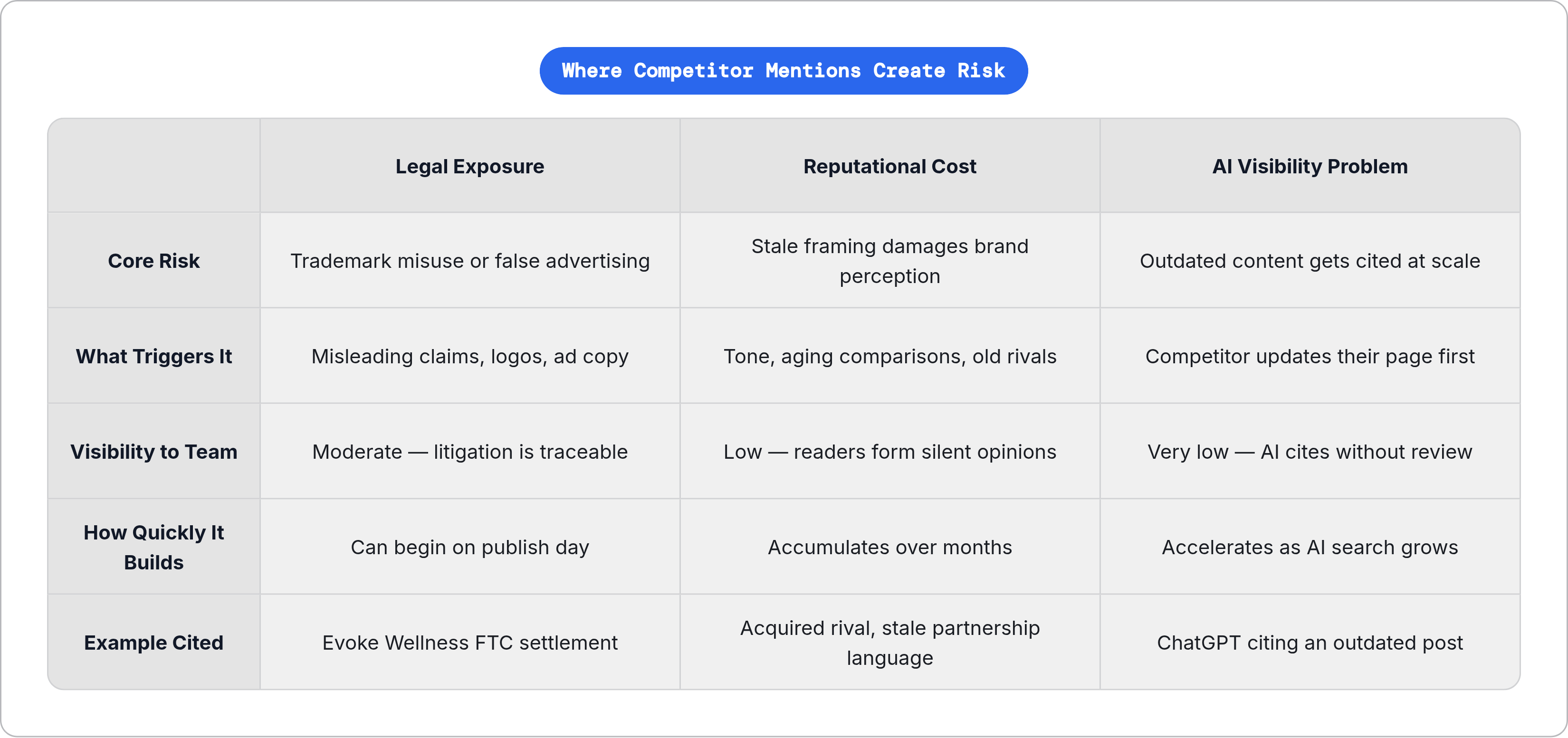
Mentioning competitors in your content costs you something, even when it never turns into a lawsuit. There's legal exposure, reputational drag, and now an AI visibility problem, and all three build up quietly while nobody's watching, because most companies publish the mention once and never look at it again.
Here's the thing though: naming competitors is a legitimate, common practice. Your prospects already know who your competitors are. They've read the analyst reports, browsed the review sites, seen the competitor's own ads. Publishing your own comparison content means you get to set the frame instead of watching from the sidelines while someone else does it for you. Research from Label Insight found that most consumers say they're more loyal to brands they see as transparent, and comparison content, done honestly, is a transparency move.
The decision to mention a competitor carries risk mainly in what happens after publishing. No one revisits the post. No one checks if the pricing claim still holds. No one owns the question of whether the framing aged well. And brand reputation risk shows up again and again on the list of things executives worry about most; unmanaged competitor mentions sit right in the middle of that risk, quietly, for years.
Where legal exposure begins: trademark law and what counts as misuse
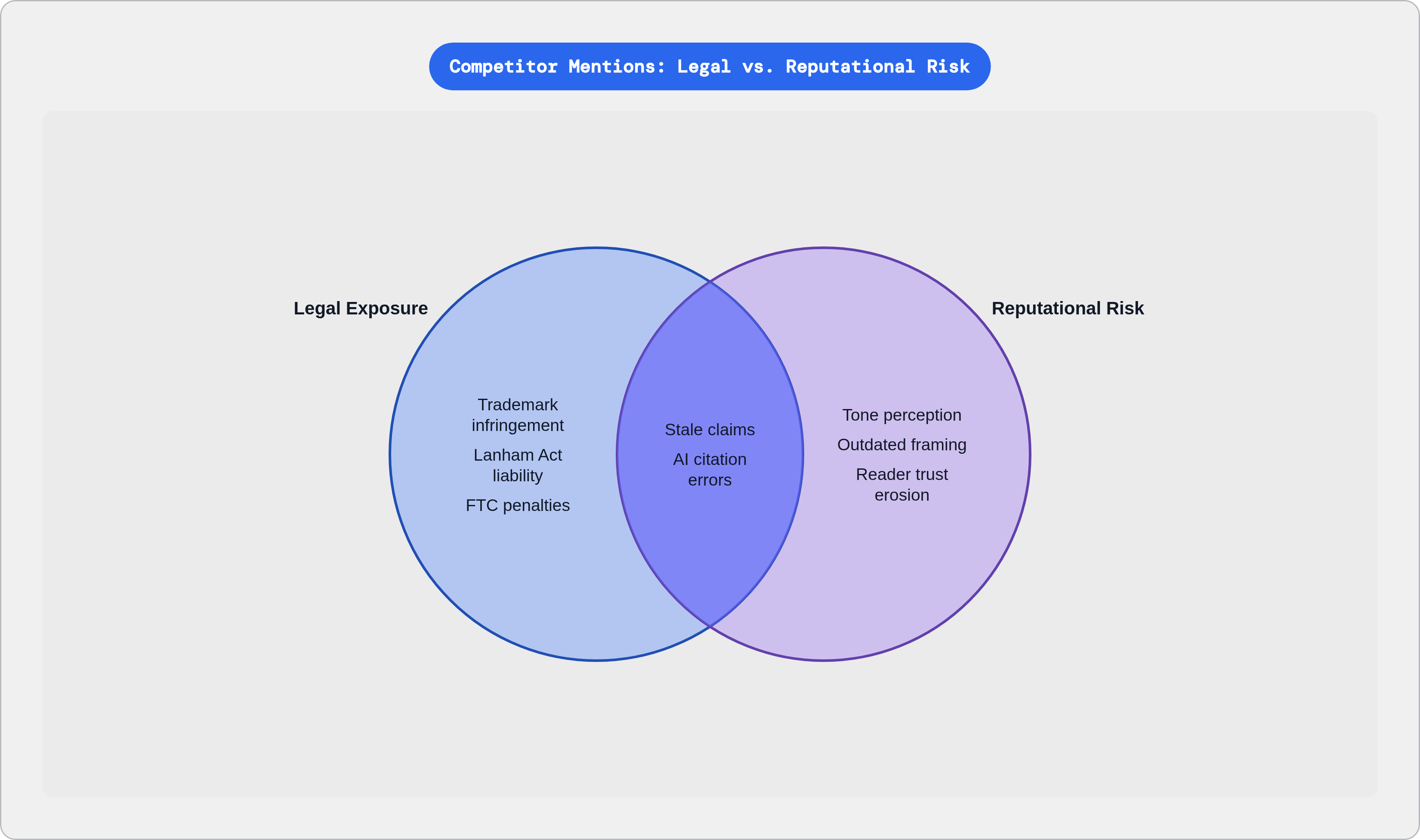
Start with the basics. A competitor's name, their logo, their color scheme, even their slogan, can all be protected marks under U.S. trademark law (the Lanham Act specifically). The thing that gets companies in trouble isn't intent. Nobody has to prove you meant to confuse anyone. The legal trigger is "likelihood of consumer confusion," full stop.
There's a safe harbor here, and it's worth knowing by name: nominative fair use. You're allowed to refer to a competitor by name when there's no other reasonable way to identify them, as long as you use only what's needed and don't suggest they endorsed you. This comes from a Ninth Circuit case, New Kids on the Block v. News America Publishing, where newspapers ran reader polls about the band. The papers used the band's name to run the poll, nothing more, and the court laid out a three-part test that still governs this area today.
In practice, this means naming a competitor in a blog post for context is generally fine. Using their stylized logo or their specific brand colors next to their name starts pushing past nominative fair use into territory that's harder to defend. And using their name in ad copy or meta descriptions in a way that implies some kind of partnership or affiliation? That's where actual litigation risk kicks in.
There's an older case worth knowing here too: Brookfield Communications v. West Coast Entertainment. The court found that putting a competitor's trademark into meta tags counted as "initial interest confusion," even though meta tags are invisible to the person reading the page. Meta tags don't carry SEO weight the way they used to, but the legal principle behind that ruling didn't expire with the tactic.
Damages aren't abstract, either. Courts can award actual damages (lost profits) or make you hand over profits you made from the infringement. Statutory damages only apply to counterfeit cases, so that's a narrower lane, but injunctions and orders to destroy infringing material are both very much on the table. And even after the legal dust settles, the public fight itself tends to stick around in people's minds longer than the case did.
How paid and digital contexts raise the legal stakes further
Keyword advertising got a real shift in 2024. Both the Second and Ninth Circuits ruled that buying a competitor's trademark as a search keyword isn't, by itself, infringement. The clearest example is 1-800 Contacts v. Warby Parker, decided by the Second Circuit on October 8, 2024. But read the ruling closely and you'll see it turned on the plaintiff failing to show a likelihood of confusion, not on keyword bidding being categorically fine. That standard is still very much alive, and still very litigable. Google will let you bid on a trademarked term, but it will restrict what you say in the ad copy itself if the trademark owner files a complaint.
Then there's Evoke Wellness, a case that shows what this looks like when it goes wrong in the real world. In June 2025, the FTC announced a $1.9 million settlement with the Florida-based addiction treatment company. Evoke had been buying Google search ads that displayed competitors' names, so when someone searched for a specific rehab facility, they'd click expecting to land on that facility's site, and instead got routed to Evoke's own call center. That's a settled enforcement action from this year, not a hypothetical about what could go wrong with competitor names in digital ads.
The pattern underneath both examples is simple. Google allowing you to bid on a term, or allowing an ad to run, has nothing to do with whether you're clear of the Lanham Act. Treating "the platform didn't block it" as your legal review is how companies end up carrying risk they don't know they have.
False advertising liability and what happens when comparative claims age
Comparative advertising itself is legal. The FTC is fine with you naming a competitor to point out where you're different, as long as what you say is true and not misleading. The catch is that "true" has an expiration date, and once a claim crosses over into false, the legal protection you had disappears with it.
This is the part that catches most content teams off guard, because nobody does anything wrong on purpose. Prices change. Features ship or get cut. Benchmarks age out. Rankings shift. A comparison post that was completely accurate in January can be misleading by June, and the post is still sitting there, still indexed, still ranking, saying the same thing it said six months ago. A price comparison implies the plans are still lined up the same way. A screenshot implies the competitor's product still looks like that. A "best in class" claim implies you're still winning that race today, not five months ago.
The penalties aren't nothing, either. Under 16 CFR 1.98, certain FTC Act civil penalties assessed after January 17, 2025 can run up to $53,088 per violation. Notice the phrase "per violation." A single blog post with four stale comparative claims in it isn't one problem, it's potentially four.
For a sense of how big these disputes can get when someone actually litigates instead of settling, look at Monster Energy's suit against Vital Pharmaceuticals over Bang energy drinks. Monster challenged Vital's ingredient and benefit claims on false-advertising grounds and walked away with $293 million in damages. Nobody's saying your blog post is headed for a $293 million verdict. But it shows you the ceiling exists, and it's a lot higher than most marketing teams assume.
Reputational costs that don't require a lawsuit to materialize
Here's a cost most teams never even clock: every time you name a competitor, especially with a link, you're handing your own readers a map to that competitor. Someone reading your comparison post who'd never heard of your rival now has. Your content becomes the introduction, which can undercut the outcome you were going for.
There's also a narrative problem that shows up over time. A comparison written when Company A and Company B were head-to-head rivals can turn into nonsense a year later once one of them pivots, gets acquired, or becomes a partner instead of a threat. The old comparison language just sits there, unaware that the world moved on. And readers who come across that stale piece don't think "oh, this must be outdated." They think this is what the company believes right now.
Brand reputation risk isn't a box you check once during a content review. It's ongoing, the same way you'd monitor uptime or customer complaints. Winning a legal dispute doesn't erase what people remember about the fight itself; the resolution fades faster than the memory of the controversy. Most of this reputational cost is invisible in the sense that no one files a complaint about it. Readers just quietly form an opinion about your company based on the tone of how you talked about someone else, and you never find out.
How stale competitor content creates AI visibility problems on top of legal and reputational ones
Competitor comparisons go stale faster than nearly any other kind of content you publish. Features change constantly. Pricing shifts. Products get discontinued. Companies get bought or merge or rebrand. A comparison piece that isn't kept current starts presenting old facts as if they're current facts, and now you're confusing the exact readers you were trying to inform.
AI search adds a new wrinkle on top of the old ones. Tools like ChatGPT with browsing turned on, Perplexity, Copilot, and Gemini pull from the live web and tend to favor content that looks fresh when the query is time-sensitive, which comparison queries almost always are. So a page that ranked well and read as authoritative six months ago can get skipped over in favor of a competitor's page that was updated last week, even if your underlying product is still better.
This turns stale content into something bigger than an SEO problem: it's an AI citation problem, and it has real revenue attached to it. AI Overviews now show up on a meaningful chunk of shopping-related searches, and ChatGPT alone has hundreds of millions of weekly users asking exactly these kinds of comparison questions. If an AI model cites your outdated post and repeats a claim about a competitor that's no longer true, you've created false-advertising exposure through a channel you never touched directly and can't easily correct. And the company that most recently published an accurate, well-organized comparison is usually the one the AI decides to cite. Leaving your old post untouched is a gift to whichever competitor updated theirs first.
What a governance system for competitor mentions actually needs to do
Most content teams have the same gap: someone writes the mention, it gets published, and then nobody ever looks at it again. There's no flag that goes off when a claim goes stale. There's no consistent approach to how competitors get described across different blog posts, landing pages, or sales decks. And there's no audit trail connecting your published content back to actual legal exposure, so nobody even knows where to look when something goes wrong.
Fixing that doesn't require anything exotic. You need a record of every competitor you've mentioned, where you mentioned them, and in what context, so that when a competitor changes something about their product or pricing, you know exactly which of your pages need a second look. You need some kind of freshness trigger, a process that prompts a review whenever pricing, features, or the competitive landscape is likely to have shifted. You need a clear line between mentions that were deliberate and reviewed versus ones that slipped in by accident, because those two carry very different levels of risk and shouldn't get treated the same. And any change to how a competitor gets described should go through a human, because an automated system quietly rewriting comparison language on its own creates a new source of liability instead of removing the old one.
AI visibility raises the stakes on all of this rather than lowering them. If AI models are reading your content and using it to answer real buyer questions, the accuracy of what you say about competitors stops being just a legal concern or a brand concern. It becomes a question of what AI systems are telling people about your competitors, on your behalf, without you in the room. A stale claim that used to just sit quietly in an old blog post that got a trickle of traffic can now get pulled into an AI answer and served to a much larger audience, all without anyone reviewing it first.
Mentioning competitors remains a legitimate, often smart part of a content strategy. The real question is whether you've built anything that keeps those mentions accurate once the world underneath them changes, which it always does.