What Happens to Customer Data When a Third-Party API Returns Malformed Responses
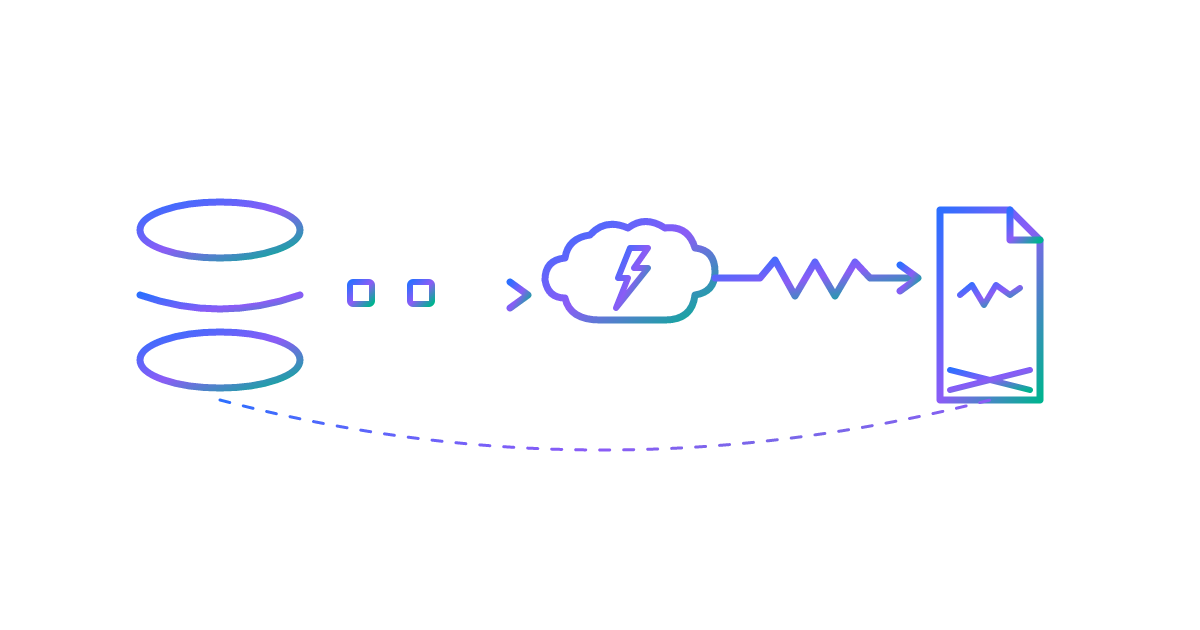
Malformed doesn't mean broken. That's the first thing worth getting straight. A malformed response was delivered. It just arrived structurally or semantically wrong. Your system accepts it, processes it, and moves on without complaint. Think of it like getting a letter with the wrong address written inside. The postal service did its job perfectly. The problem is what's written on the page.
That distinction matters because "broken" triggers alerts and "malformed" doesn't. The dashboard stays green. The logs look clean. And somewhere downstream, a customer's data is quietly wrong.
Wrong content type (HTML instead of JSON)
A checkout flow works perfectly in staging. Hits production. The third-party endpoint returns an HTML error page instead of JSON. A WAF rule, a misconfigured load balancer, a redirect that only fires under real traffic — whatever the cause, the try-catch block swallows the parse error. The integration doesn't throw.
Some customers assume the transaction went through and leave. Others retry and get duplicate charges. Some just go to a competitor. No error log fires that looks obviously wrong.
Schema drift (field renamed, deleted, or added)
This is the most common cause of silent data-flow failures in production, and it's almost always unannounced.
Harvest renamed client.name to client.displayname. Integrations that hadn't updated their parsing logic returned empty strings. Customer profiles went blank. Okta renamed userid to sub. Systems still parsing for the old field received null values and wrote phantom records downstream. No error logs either time.
Industry data consistently puts this above 60% of production pipelines that don't run automated contract testing. More than six in ten pipelines, just sitting there, waiting to catch a renamed field.
Data type mutation
The field exists. The name didn't change. But the value that comes back is a different type than it used to be. Splunk changed threat severity from a string ("high") to a numeric value (8). Comparisons like if severity == "high" silently failed. Alerts still arrived. Severity-based routing broke entirely. No exception thrown.
The metrics looked clean. The routing was just wrong.
Nested restructuring
AWS Security Hub restructured finding metadata from flat fields to nested objects. Integrations expecting finding.severity started receiving nothing because the path had moved to finding.details.severity. Security findings went unprocessed for days. The data was there the whole time. The path to it had changed, and nobody's monitoring caught it.
200 OK with an embedded error payload
This one quietly breaks HTTP semantics. The server returns a success status code and buries an error message in the response body. Client libraries see 200 and never look further. Monitoring tools see 200 and mark the call successful. The integration proceeds as if the data is valid, and the embedded error message gets written into the record as a real value.
Standard monitoring is structurally blind to this. Not because it's misconfigured — it's doing its job correctly. Its job just doesn't include reading the body.
What Happens to Customer Data Between the Malformed Response and the Moment Someone Notices
There's a window between a malformed response and anyone realizing something is wrong. It has a predictable shape, and each phase makes the problem harder to fix and more expensive to clean up.
Ingestion. The bad field value is accepted without an exception because the response structure is technically valid. The parser doesn't know a field that used to say "Sarah Chen" now says nothing. It accepts nothing and moves on.
The write. Corrupted or null data commits to the database with a clean stack trace. As far as the system is concerned, the write succeeded. It did succeed. The data is just wrong.
Propagation. This is where a contained problem becomes a distributed one. The corrupted record fans out:
- Email workflows act on a null identifier and fail silently, or route to the wrong addresses
- Analytics pipelines ingest the corrupt value, and every aggregate built on top is now off
- Search indices bloat or mis-categorize records
- CSV exports and audit logs carry the corrupted value forward
Downstream systems don't know what the original record was supposed to say. They trust what they receive. That's their job too.
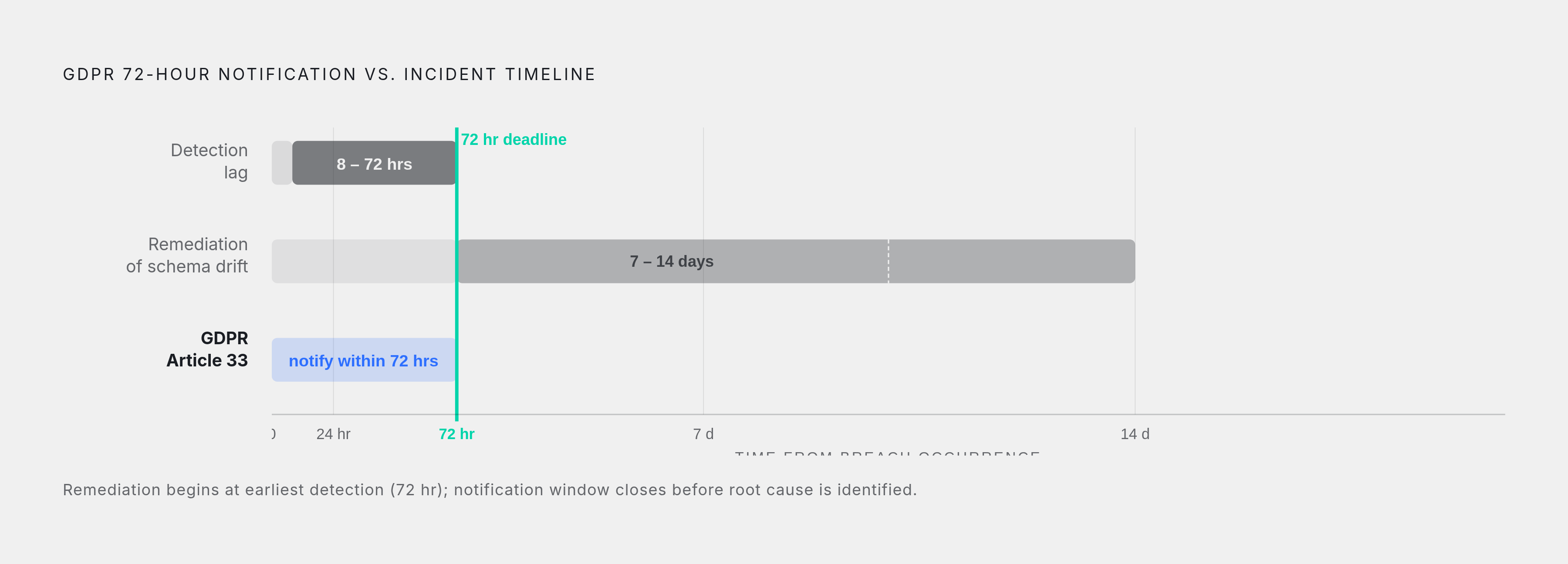
Detection lag. The typical window between the triggering change and someone noticing something odd sits somewhere between 8 and 72 hours. Then the real timeline kicks in: engineering looks at their own code first, because that's where the symptoms live. Root cause eventually gets traced to an upstream vendor change. The connector gets rewritten, tested in staging, and deployed. Meanwhile, days of data are wrong. Manual remediation after schema drift takes 7 to 14 days on the short end.
Reconciliation cost. By the time the fix is live, every downstream report, dashboard, and audit trail that touched the corrupted table needs to be re-examined. You're not just fixing a pipeline. You're auditing everything that pipeline fed. McKinsey research puts the reactive investigation burden from silent pipeline failures at up to 30% of data engineering time. Not 30% on a rough week. As a running baseline.
Why the Third-Party Origin of the Problem Makes It Harder to Catch and Harder to Defend
When you integrate a third-party API, you inherit that vendor's data quality and security posture. You don't get to negotiate that. It's what integration means.
Vendors are under no obligation to notify integrators when they change the shape of a response. A response-shape change is a code update on their side. It doesn't appear on status pages. It doesn't generate an incident ticket on your end. It just happens, and the first signal you get is a support ticket from a customer who noticed something weird.
The McDonald's McHire incident in 2025 illustrates how this plays out at scale. Vulnerabilities in a third-party hiring platform exposed sensitive data belonging to McDonald's job applicants. McDonald's correctly attributed the vulnerability to the third-party provider. The reputational damage fell on the brand the applicants had actually trusted. That's how liability distributes in practice: technically upstream, publicly yours.
IBM's 2025 Cost of a Data Breach Report puts third-party and supply-chain compromises as the second most frequent attack vector. Involved in 15% of breaches. Second costliest, averaging $4.91 million per incident. The trajectory is particularly uncomfortable: third-party involvement in breaches doubled from 15% to 30% in a single year. The exposure surface is growing faster than most teams' third-party monitoring practices are.
The detection gap is what compounds everything. Supply-chain compromises took nearly 267 days on average to detect and contain (IBM 2025). Not 267 days to fix something. 267 days before anyone knows there's something to fix. That's a fundamentally different category of problem, and standard vendor monitoring is built for a different kind of visibility entirely.
When Corrupted Customer Data Becomes a Regulatory Event
Most engineers picture a data breach as something involving an attacker. GDPR's definition is broader, and the gap between those two mental models matters more than most people realize until they're already in it.
Mistakenly overriding, deleting, or introducing errors into personal data counts as a notifiable breach under GDPR. Even when the cause is a vendor mistake. Even when it's incompetence rather than malice. A malformed API response that corrupts a customer's PII record triggers Article 33 obligations. That's not a creative interpretation. That's what the text of the regulation says.
Article 33 requires notification to the relevant supervisory authority within 72 hours of becoming aware of a breach. Go back to the detection timeline: 8 to 72 hours to discover the problem, 7 to 14 days to fully remediate. The notification window closes before root cause is even identified. You're required to report an incident you don't yet understand to a regulator who expects you to understand it.
Average daily breach notifications across the European Economic Area surged 22% in 2025, hitting 443 per day per the DLA Piper GDPR Fines and Data Breach Survey from January 2026. First time since GDPR came into force that daily notifications exceeded 400. Customer PII is involved in 53% of breaches per IBM 2025, which is precisely the data flowing through the integrations most likely to carry malformed responses.
Third-party liability is not a defense in regulatory proceedings. A fintech startup was fined €6.5 million when an offshore analytics provider's storage was exposed, despite having no direct hand in the breach. They were the data controller. Controllers absorb the consequences. Maximum penalties under GDPR reach €20 million or 4% of annual global turnover, whichever is higher. CCPA carries parallel obligations with a different notification structure, but the liability pattern is the same.
How Malformed Responses Cross From Data Quality Failures Into Active Security Vulnerabilities
There's a line between an accident and an attack. It's thinner than most teams realize, and the gap between them is mostly intent.
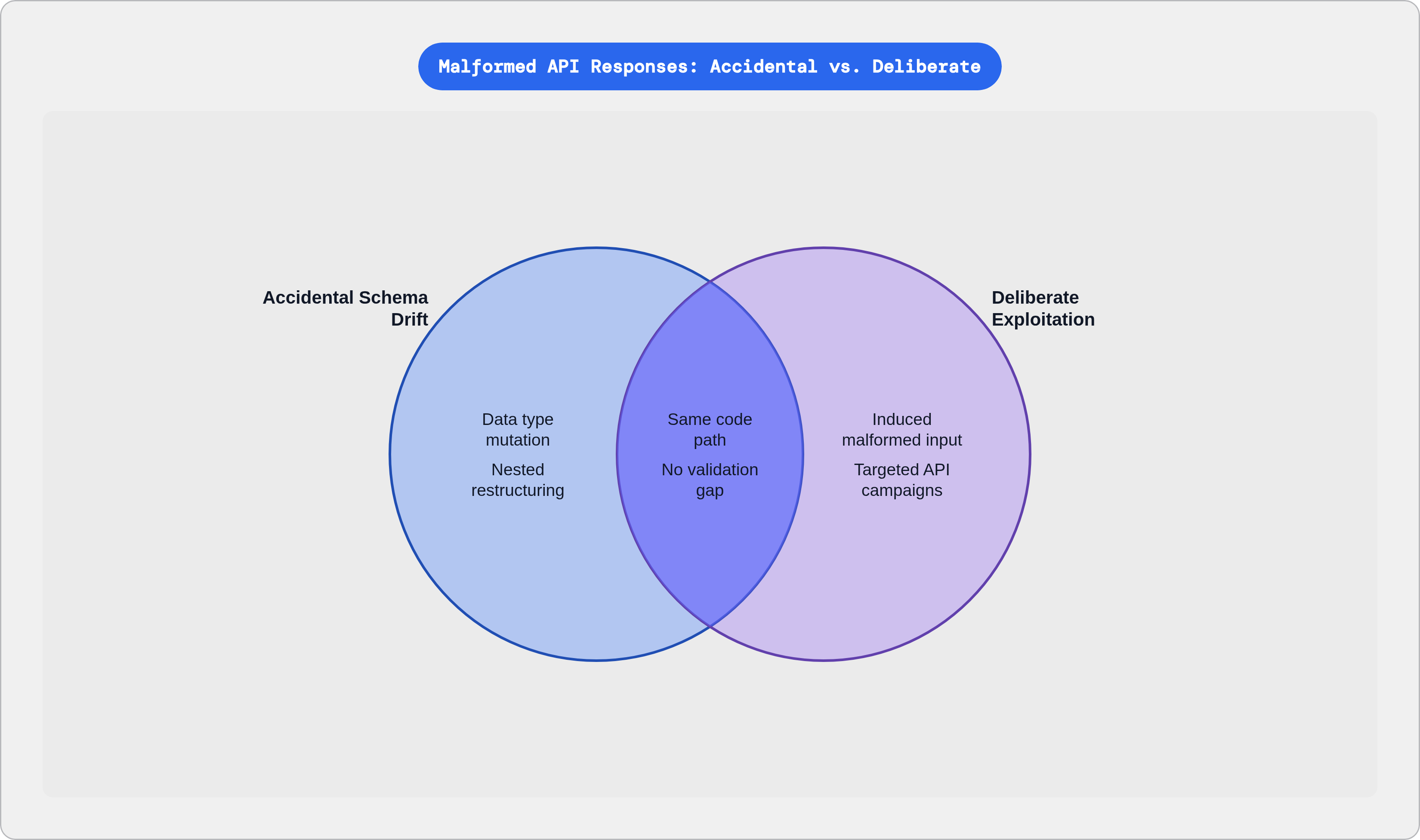
A vendor-side schema change is accidental. An attacker who understands how your integration parses responses can induce malformed inputs deliberately. And here's the uncomfortable part: integrations that omit response content validation before acting on it are equally vulnerable to accidental schema drift and deliberate manipulation. Same code path. Same gap. The only difference is who found it first and what they decided to do with it.
The scale of active exploitation is not abstract. Within one week in March 2025, over 10,000 exploit attempts were logged from a single IP against a known API vulnerability (CVE-2024-27564). That's a targeted campaign against a specific failure mode.
The DeepSeek incident in 2025 showed how fast a response-handling gap can escalate. Over one million log entries containing chat histories, API keys, and access tokens were exposed through API response mishandling. Not through a sophisticated intrusion. Through a gap in how responses were handled. Financial services API-related fraud losses exceed several billion dollars annually. A 2024 healthcare API breach exposed millions of patient records through broken object-level authorization.
The common thread across all of it: integrations that act on response content without validating it first. The accidental version corrupts data. The deliberate version weaponizes the exact same behavior. From the code's perspective, those two scenarios are identical.
Why Standard Monitoring Setups Miss Malformed Responses Until the Damage Is Done
Uptime monitoring measures whether the endpoint responded. Latency monitoring measures how fast. Neither validates what came back. That's not a design flaw in those tools. They do what they were built to do, and they do it well. What they were built to do just isn't this.
Status code monitoring misses the 200-OK-with-embedded-error failure entirely. The code is 200, the tool reports success, the body is never inspected. Vendor status pages cover incidents the provider decides to disclose, and a response-shape change is a code update on their end, not an outage. It won't appear anywhere you'd normally look.
Log-based detection fails for the same reason the write succeeds cleanly: when a field goes null, the application writes null without complaining. Nothing in the log registers as an error. The log says everything worked, and it's technically correct.
Alert fatigue makes all of this worse. Teams monitoring large numbers of third-party integrations tune out low-severity anomalies, and that's exactly where schema drift first surfaces. A slightly elevated null rate on a single field doesn't look like a crisis. It looks like noise. Until you look back at it three weeks later and realize it was the start of something bigger.
The practical result: payment providers, identity platforms, messaging services, and data vendors embedded directly in core workflows can degrade softly, and your application's health metrics stay green throughout. Detection has to move to the response body, validating structure and semantics against a known schema on every response, rather than just confirming that a response arrived at all.
Practical Defenses at Each Layer of the Response Lifecycle
This is fixable. Not all at once, not for free, but fixable if you approach it by layer rather than trying to solve it in one pass.
At the schema layer
Run automated contract tests against live third-party responses, not just your own API surface. Use JSON Schema validation at the integration boundary. Reject or quarantine responses that fail to conform before any write occurs. Track schema versions explicitly so that an unexpected field addition or removal surfaces as a signal rather than a surprise you discover days later.
At the ingestion layer
Never assume a field is present. Never assume a type is stable. Distinguish between "field missing" and "field null" in your data model because both carry different information about what went wrong. For type-sensitive fields like amounts, identifiers, and severity levels: cast explicitly and fail loudly if the cast breaks. A loud failure at ingestion is genuinely useful. It tells you exactly where and when the problem started. A silent write of wrong data tells you nothing until a customer notices.
At the write layer
Stage inbound data before writing to production tables. Validate against business rules before promoting to the live record. Use idempotency keys on writes that touch financial or identity records. That's what prevents the retry storms that follow an HTML-instead-of-JSON failure from creating duplicate charges.
At the monitoring layer
Alert on field-level anomalies: null rates, type distributions, value-range violations. Track more than 5xx rates. Track schema fingerprints across responses over time because a fingerprint change is an early warning, not a confirmed incident. That lead time is the difference between a team investigating before customers notice and a team apologizing after. Run synthetic transactions that exercise the full response path, rather than uptime probes that only confirm the endpoint is alive.
At the vendor relationship layer
Require advance notification of API changes in vendor contracts. Build staging environments that can receive vendor pre-release schema changes. Maintain documented data processing agreements that assign clear responsibility when a vendor-side change causes data corruption. The 267-day average detection time for supply-chain compromises is partly a monitoring and governance problem, not purely a technical one. Contracts and communication cadences belong in the defense stack alongside the code.
At the infrastructure layer
At some point, keeping dozens of third-party APIs in sync stops being a build problem and becomes ongoing operational work. Each upstream vendor change requires someone to discover it, understand it, patch the connector, test in staging, and deploy. Multiply that across the number of integrations a mature product depends on and you start to see where engineering time actually goes.
Pre-built, maintained connectors shift the schema-tracking burden off product engineers. When a vendor renames a field or restructures a response, a well-maintained connector layer absorbs the change rather than requiring each integrating team to find it independently and patch it on their own timeline. The operational argument is simple: it converts unpredictable reactive cost into expected, handled overhead.
The point of layering all of this isn't to make malformed responses stop happening. They won't. Vendors will keep shipping changes without notice, fields will keep drifting, and someone somewhere will keep returning 200 when they mean 400. The goal is that when a malformed response arrives, it's loud at ingestion, contained before the write, and visible to someone long before the 72-hour regulatory clock runs out.